Showing posts with label new england cooking. Show all posts

Wednesday, December 2, 2015

Making Wine Out of Vinegar


Brussel sprouts.....ugh! I know many of you think that way about these little green beebees and all too often, reminding you of why you don't eat cabbage. So in order to "re-acclimate" your taste buds, we need to rid this veggie of that aftertaste.

We don't merely want to mask the bitterness with a ton of fat and bacon, or to put layers of seasonings to it. We want to rid it of bitterness.

Relatively new in the flora department, brussel sprouts have only been cultivated, as such, for consumption since the early 1500s, but mentioned in the country of popularity, Belgium, 300 years earlier. The bitter taste of each 'bud' has been a bane to palates since that time, cooks offering their own solutions to make them more palatable.

The predominant reason for eating brussel sprouts, too many, is the outrageously beneficial properties, especially in the antioxidant department.

To begin with, when using brussel sprouts, make sure they are small, rock-hard little orbs. This means they are young with less of the bitter taste to deal with.

But if it is the flavor you savor, minus that bitterness, there is a new way of subduing, or even eliminating, this off-taste. It is the acidic compound known as thiocyanates that are released that is the issue. Certainly boiling them in water releases these compounds, reducing the unpopular flavor. But it is still obviously there.

There IS an alternative to severely cutting the bitter taste, almost eliminating it, and you will see it first here, by The Yankee Chef.

The key is substituting one ill-tasting acidic element with a sweet tasting acid. I like to use apple juice first and foremost. It is one of the highest acidic fruits, believe it or not, with the perfect flavor to transform brussel sprouts. The ph level in apples ais generally 3.3, which is almost equal to orange juice.

To start, always cut them in half first and cut off any visible stem. This not only helps to leach out some thiocyanates but also helps the sprout to absorb the good acid, apple juice in this case. If you want to experiment, use orange or cranberry juice, tamarind or even the top acidic fruit of all, a star fruit. A good reference would be the higher the Vitamin C level, the higher the acidic level will be.

So back to the preparation. After you have cut your brussel sprouts in half, place them in a pot of apple juice and let them soak for at least 2 hours, then boil them in the same juice for only 2 minutes, just enough to barely warm them through. Drain well and use in any preparation you desire.

Now for a great recipe that is packed with flavor, without masking the the overall taste. I have yet to taste any bitterness every time I use the above method or the recipe below. I highly suggest you stay away from frozen brussel sprouts. Freezing completely destroys the texture, almost to the point where they are soft the moment you thaw them.

Brussel Sprouts Amaro a Dolce

Simply meaning 'bitter to sweet' in Italian, these sprouts are absoltely the perfect accompaniment to any turkey, pork or Prime Rib you will be having on the table this Holiday season. You may even get the kids to try them. A beautifully arranged taste of New England with Italian accents.


1(12-ounce)bag fresh brussel sprouts(about 2 cups)
2 cups 100% apple juice
1-2 strips bacon, diced
1/4 teaspoon cinnamon
Large pinch each ground cloves and red pepper flakes
1/2 cup apple jelly*
Dash apple cider vinegar

Prepare brussel sprouts by cuting off any protruding stem and cut each head in half. Place in a large bowl with apple juice, using more if needed to completely cover. Soak at least 2 hours at room temperature.

Preheat oven to 400-degrees F. Transfer brussel sprouts and juice to a large saucepan and boil 2 minutes. Immediately drain, discarding liquid; set sprouts aside. Place bacon in a large skillet over medium heat and cook until just done but not crisp. Remove from heat and discard fat. Add brussel sprouts; set aside. In a bowl, whisk together apple jelly, cloves, red pepper and vinegar. Pour into pan with brussel sprouts and toss to evenly coat. Transfer to an 8-inch pan and roast 40-50 minutes, or until browned on top. Half way through cooking, stir them well. If desired, place them under the broiler for a minute to brown even more. Remove from oven to serve immediately.

Makes 4(1/2-cup)servings


*Maple syrup is a nice substitute in this recipe as well

Sunday, May 31, 2015

Summer Sprouts

Yup. It's that time of year where we start thinking that we really shouldn't have had that extra slice of cake, that additional helping of lasagna or stuffed ourselves during the Holidays. But then again, it may have well been worth it. But for those of you who DO have that guilty conscience, this post is right up your alley.
For those of you who are lucky enough to have a high metabolism, try these recipes just because they are delicious, great for you and simply a great side to anything you have grilling this summer.

Summer Picnic 'Salad' 

A light meal that fits that "feel-good" category of recipes. And as for the Apple Vinaigrette? Let's just say this will be the last vinaigrette recipe you will make. Beautifully tart and reminiscent of that ol' Yankee charm, it is a keeper.


Apple Vinaigrette Dressing:

1/2 cup frozen apple juice concentrate, thawed
1/3 cup water
3 tablespoons apple cider vinegar
1 tablespoon honey
2 teaspoons lemon juice
1/4 cup extra virgin olive oil
Salt and black pepper to taste
"Salad":
1(7-ounce)bag bean sprouts(4 cups)
1 teaspoon minced garlic in oil
1/2 teaspoon chili powder
1 cup whole kernel corn
1 apple, peeled, cored and diced
1/4 cup diced water chestnuts

Begin by adding apple juice, water, vinegar, honey and lemon juice to the bowl of a food processor or blender. Pulse on high for 10 seconds and keep it running. Slowly add the olive oil to the dressing until all ingredients are emulsified well; set aside.
Get 1 quart of water boiling over high heat. Gently add the bean sprouts and boil, stirring once, for 2 minutes. Strain well and transfer to a bowl; let cool to room temperature. When ready to serve, toss with garlic, chili powder, corn, apple, water chestnuts and Apple Vinaigrette Dressing.

Enough for 4 servings


Sautéed, Saucy Sprouts
 

This is one recipe you will eat all by itself. Loaded with protein, without added fat, it is one of those feel good meals. For an even higher boost of protein, without fat, add some cubed tofu. For those of you who want a little "meat with your potatoes", so to speak. add some chicken or beef cut up small while sautéing onions and garlic.

3/4 cup vegetable broth
1/3 cup soy sauce
1/4 cup apple cider vinegar
2 tablespoons brown sugar
1 tablespoon sesame oil
2 tablespoons canola or peanut oil
1/4 cup minced onion
1 teaspoon minced garlic in oil
2 cups(8-ounces) sliced mushrooms
1 cup frozen lima beans, thawed
1(7-ounce)bag bean sprouts(about 4 cups)


Whisk together vegetable broth, soy sauce, vinegar, brown sugar and sesame oil in a bowl; set aside. In a large skillet, over medium-high heat, add canola oil until it is shimmering hot. Add the onions and garlic and stir-fry for 1-2 minutes, or just until the garlic is becoming fragrant. Add mushrooms and lima beans. Stir fry for 4-5 minutes, or until the mushrooms are tender. Add broth mixture and bring to a boil. Stir in the bean sprouts and continue cooking and stirring for 2 additional minutes. Remove from heat to serve immediately.

Asian Shrimp Omelets
 

Every once in a while, I make breakfast for lunch or supper, never giving any thought to an alternative that is considered both in the 'other East'. Asian-style omelets are eaten throughout the day and after a few bites, you will see why.


3-5 tablespoons oil, divided
3 green onions, sliced thin
1 rib celery, minced
2 ounces(about a cup) mushrooms, minced
1 cup vegetable or chicken broth
1 tablespoon cornstarch
1 teaspoon brown sugar
2 tablespoons soy sauce
8 eggs, beaten well
1/2 teaspoon each salt, black pepper and chili powder
8 ounces beans sprouts, chopped
8 ounces Maine or salad shrimp, chopped

Heat 1 tablespoon oil in a small skillet. Add celery and onions, cooking until the celery is softened, about 3 minutes, stirring occasionally. Add the mushrooms and cook until soft, about another minute. Remove from heat, drain and set aside.

In a small saucepan, whisk together broth, cornstarch, sugar and soy sauce and cook over medium heat until it boils and thickens, about 4-6 minutes. Set aside, covered, to keep warm.

In a large bowl, stir together eggs, spices, bean sprouts, shrimp, celery and mushrooms. Add a half tablespoon oil to a skillet over medium heat until hot. Pour in 1/4-1/2-cup measures of omelet batter to skillet and cook until browned on both sides, about 2-3 minutes per side. Transfer to plate and continue until all omelets have been made. Pour soy mixture over the top and serve immediately.

Enough for 4 people


Thursday, March 12, 2015

"I am a drinker, with a writing problem."

That was a quote attributed to Brendan Behan, a well-"versed' Irish poet, novelist and playwright, which plays right into this post.


Ireland......The very first thought that comes to mind is green pastures, rolling hills and, of course, a tip of the glass. It wasn't that long ago that the Irish that immigrated to America were "cartooned" as brawling drunkards whose last dime went into the bottle

Now that times have changed, St. Patrick's Day has many declaring their ancestry as Irish, regardless if their name is Baryshnikov, St. Pierre or Polanski. In fact, more than 30 % declare themselves of Irish ancestry in the days leading up to St. Patrick's Day and when the same poll is taken 30 days afterward, only 16 % say they are of Irish stock.

Many seek any reason, really, to indulge in original Irish liquor on just one day of the year. And Ireland is known for the superior spirits that are enjoyable straight from the bottle or mingling with other ingredients to result in a tasty treat, even if you aren't a drinker.


Ireland is much like New England. Not only does liquor bring the worst out in people, but to most of the Irish, it enhances togetherness and warmth, much like rum's effect on our fore-families. Their meals are simple and inexpensive yet provide the comfort feeling we Yankees are known for.

Let me give you just a few examples of this simplicity, but with a New England influence.


Crispy Irish Maslin Bread


Maslin literally means brass, but it also refers to a variety of grains used in the baking of bread. So keeping with tradition, in a way, I am including different grains as well as a surprise ingredient that I think you will find a perfect fit.


If you don't have buttermilk on hand or just don't want to purchase it, the perfect substitute is mixing 1 tablespoon vinegar or lemon juice in the same amount of whole milk and let it sit for 30 minutes, or even longer. It will curdle, which is exactly what you want. The interaction of this with baking soda gives this perfectly salty/sweet bread that distinctive hollow sound and the flavor is will remind you of an old world bake shop, in Ireland of course.


Nonstick cooking spray
2 1/2 cups whole wheat flour, plus extra for kneading
1 cup oat flour*
1/2 cup finely crushed graham crackers
1 tablespoon baking soda
1 1/2 teaspoons salt
3 tablespoons cold butter or margarine
1 1/4 cups buttermilk
1/4 cup honey or maple syrup
1 egg, lightly beaten
Extra honey or maple syrup for brushing the top

Preheat oven to 375-degrees F and position oven rack to the upper portion of the oven Grease a baking pan with nonstick cooking spray. In a large bowl, combine both flours, graham crackers, baking soda and salt. Add butter and cut in using either 2 knives, scissor fashion or a fork. Stir in buttermilk, honey and egg, mixing well. Turn out onto well floured work surface and knead for a minute, or until smooth and elastic. Brush off excess flour and place in the middle of the prepared pan. Brush the top with honey and sprinkle extra rolled oats over the top, slightly pressing into the dough. Mark the top with a serrated knife with two 1-inch deep gashes. Bake 40-45 minutes, or until very well browned all over. Remove to cool slightly before serving.


* Simply place the oats in a blender or food processor and have at it. In a few seconds on high and you will have powdered rolled oats, or oat flour.


Perfect Irish Yankee Soda Bread(Spotted Dog)


Yankee because of the sweet/tangy addition of dried cranberries and Soda because of the soda used........just kidding. This is called soda bread because of the chemical reaction of baking soda with buttermilk. It gives you the perfect rise and density found in old world-style breads while the crispy browned exterior is ideal for breaking open to enjoy.


Nonstick cooking spray
4 cups flour, plus extra for kneading
2 tablespoons sugar
1 tablespoon baking soda
1 1/2 teaspoons salt
4 tablespoons butter or margarine
1 1/2 cups buttermilk
1 egg, beaten well
3/4 cup dried cranberries
2 teaspoons caraway seeds, optional


Preheat oven to 375-degrees F and position oven rack to the upper portion of the oven. Grease a baking pan with nonstick cooking spray. In a large bowl, combine flour, sugar, baking soda and salt. Cut in butter with two knives, scissor fashion or use a fork. Add the buttermilk, egg, cranberries and caraway seeds, mixing well to form a dough. Turn out onto well floured work surface and knead for a minute or so, until smooth and elastic. Form into a round loaf, brush off excess flour. Place in middle of prepared pan and spray the top with nonstick cooking spray. Bake for 40-45 minutes, or until well browned all around. Remove from oven to cool slightly before tearing into.


Bailey's Irish Whiskey Cake

Yes, I already know. There is no such thing as Bailey's Irish Whiskey. This beautifully scented, Irish cake is, however, brought to you by a Bailey and has a hint of Irish Whiskey both in the cake and on 'top'. You can, however, substitute a few drops of rum extract in the milk below or just leave out any hint of alcohol, and its' taste, altogether. The curdled milk is a great way of adding buttermilk flavor without the added expense while giving this upside down cake perfect flavor and moistness.

1/4 cup whole milk, half-and-half or light cream
1/2 cup Irish Apple Whiskey or Irish Apple Liqueur, divided
1 teaspoon lemon juice
3/4 cup(1 1/2 sticks) butter or margarine, divided
1/4 cup brown sugar
1 large, firm apple. peeled, cored and wedged 1/2-inch thick
1/2 cup dried cranberries
1 1/2 cups flour
2 teaspoons baking powder
1/2 teaspoon ground ginger
1 cup brown sugar
2 eggs


In a small bowl, whisk together milk, 1/4 cup whiskey and lemon juice and let sit 30 minutes to curdle while preparing rest of recipe. Melt 4 tablespoons butter in a 9-inch round cake pan over low heat. Using a wooden spoon, stir in the brown sugar and cook, stirring for about 3 minutes until smooth and bubbling. Remove pan from heat.

Lay the apple slices on top of melted butter/brown sugar mixture decoratively. Sprinkle the dried cranberries over the top and evenly drizzle remainder of whiskey; set aside. In a bowl, whisk together flour, baking powder and ground ginger. In another bowl, beat remainder of butter and sugar on high until light and fluffy. Scrape down sides and add eggs; beating very well. Reduce speed to low and beat in the flour, a little at a time. Beat in the milk mixture just until moistened. Spoon batter over apples and even out top without disturbing the apple arrangement. Bake 35-40 minutes, or until toothpick inserted in middle come out clean. Cool cake in the pan for a couple of minutes and then run a knife around the edge of the pan to help release. Invert onto a serving platter or plate quickly and carefully. Serve warm or at room temperature.


Irish Apple Bread Pudding 'Pie'

This bread pudding is anything but typical. It is beautifully sweetened, less dense and 'gummy' than many other equivalent puddings and the sweet, caramelized crust that forms makes you want to just pick it off first then eat the rest later. Use whatever muffin you desire, I just happened to adore cinnamon but regardless of what you choose, make sure you have 5 cups total after cutting. Taitneamh a bhaint as!


4 large plain or cinnamon muffins
4 teaspoons butter or margarine
3 large apples, peeled, cored and diced, divided
1 cup apple juice or water
1/4 cup maple syrup
Nonstick cooking spray
3/4 cup milk
3 eggs, beaten
1/3 cup brown sugar
1 teaspoon cinnamon
1 teaspoon vanilla or almond extract
Juice and grated rind of 1 lemon
1/2 teaspoon dried ginger
Irish Butterscotch Cream, recipe below


Slice muffins horizontally about 1-inch thick. Butter all cut sides and grill over medium heat until well browned, about 2 minutes per side. Place on a plate and let cool in refrigerator for an hour, preferably overnight. Meanwhile, add 2/3 of the diced apple to a saucepan along with apple juice or water and maple syrup. Bring to a boil over medium heat, stir, reduce to low and simmer 6-8 minutes, or until it has thickened and apples are done, but still firm. Remove from heat and set aside. Spray a 9-10-inch cake pan with nonstick cooking spray liberally; set aside. Preheat oven to 350-degrees F.

Cut grilled muffins into cubes and add to a bowl along with remainder of diced apple. In another bowl, whisk together milk, eggs, brown sugar, cinnamon, vanilla, juice and grated rind and ginger. Pour over muffin cubes and gently toss to evenly coat. Transfer to prepared cake pan, evening out the top. Spoon cooked apple mixture over the top evenly and bake 40-45 minutes, or until it is firm when touched in the center with a spoon or fork. Make Irish Butterscotch Cream while pudding is baking. Remove pudding to cool slightly before running a dull knife around the edge to loosen. Cut into wedges and serve drizzled with Irish Butterscotch Cream.

Irish Butterscotch Cream

Put 1 cup whole milk, light or half-and-half cream in a saucepan with 2 tablespoons butter or margarine, 2 tablespoons each of brown sugar and Bailey's Irish Cream and 2 teaspoons honey or corn syrup. Over low heat, bring to a simmer while stirring frequently to prevent scorching. After 2-3 minutes, it will be thicker and creamier, stir in 1 teaspoon vanilla and remove from heat.


                                       Traditional Pan Haggerty

Simple? Yes! Traditional? Yes! But don't let this seemingly mundane dish prevent you from make it. There are so many things I could do to this dish to keep those "food snobs" at bay, but why play with a recipe that has been enjoyed for so long in Ireland? Us Yankees have been enjoying this dish for just as long, but called Scootin' 'Long the Shore. And as much as I would like to add this and that to our version, I decided to take the critics blows for offering a "dull and idiot simple" New England classic. My response to them? You really don't want to know!

3 slices bacon, diced
1 small onion, peeled and diced
3 large potatoes, about a pound, diced
2 cups chicken or vegetable broth
1 cup shredded Cheddar cheese
Salt and black pepper to taste
Sour cream, if desired


Heat a large oven-safe skillet over medium heat. Add and cook bacon until crisp or to your liking. Remove bacon to crumble and add back into the skillet with onion and cook an additional 5-6 minutes, or until onion is soft but not browned. Drain fat and add potatoes and broth. Stir to combine, bring to a boil and cover. Reduce heat to low and simmer 8-10 minutes(according to the size of your potato cubes), or until the potatoes are firm, but tender and the liquid has absorbed. If you still have liquid after potatoes are done, simple increase heat to medium and continue cooking, uncovered, for a few more minutes until it has evaporated and/or absorbed. Preheat broiler and place oven rack at least 3-inches from heat source. Remove skillet from burner, evenly sprinkle cheese over the top and broil until as crisp as you like. Remove to serve immediately. Top with sour cream if desired.


Tipperary Apple Pudding


I remember once, many years ago, trying a Tipperary Pippin Apple and was blown away at the perfect cooking nature of it. Of course, now there are so many more to choose from but that one taste has stayed with me all these years. So in honor of my first bite of a true Irish apple, enjoy this Yankee take on the Apple Barley Pudding that is so dear to Irish hearts, and palates. I gave this a little zing that I think is spot on. For an even warmer feel, try substituting allspice for the nutmeg.

Now many of you will be asking by now, why barley in a dessert? Many centuries ago, in Ireland, barley was a cereal grain that was widely used in kitchens during St. Patrick's time, which is only summized as being in the 5th century. So barley was used as a thickener, porridge, breads, pastries and, of course through natural progression, desserts of all kinds.

5 large apples of your choice, peeled, cored and roughly chopped
5 tablespoons pearl barley
2 cups water
2 cups apple juice
3 tablespoons lemon juice
1/3 cup sugar
1/2 teaspoon each of cinnamon and nutmeg
1 cup whipped cream or topping
1/4 cup dried cranberries
3/4 cup cranberry juice or orange juice


In a large saucepan, bring the apples, barley, water and apple juice to a boil over medium-high heat. Reduce heat to medium-low, cover and simmer for 20-25 minutes, or until barley is soft. Remove from heat and strain, reserving any liquid. Add to a food processor bowl, or in batches using a blender and puree until it resembles chunky applesauce.  Add liquid if needed to puree or more apple juice if the liquid has been fully absorbed. Transfer mixture to a large bowl and add sugar and spices, mixing well. Cover and refrigerate until cooled or serve warm.

Meanwhile, make cranberry "sauce". In a small saucepan, add cranberries and juice. Bring to a boil over medium,-high heat. When boiling, reduce heat to low and simmer 10 minutes, or until cranberries have started to take in the juice and swell. Transfer to a blender or food processor and puree until smooth. This sauce will thicken perfectly while pureeing because of the very high, natural pectin levels in the cranberries. Pour into a bowl and refrigerate until cooled.

To serve, spoon apple pudding into 3-4 serving dishes, top with whipped topping and drizzle sauce over the top.

Pearl barley has been processed, therefore it is not classified as a whole grain. But if you would like to add hulled barley(aka pot barley or barley groats) in order to obtain the fiber, simply cook twice as long, and you will need to add one extra cup of liquid because of the longer cooking time. The consistency will not be altered because of the addition of other ingredients, but if you were to cook it on its' own, it will be much chewier and sticky. And don't forget to rinse it before cooking to help keep that stickiness down.

Saturday, October 18, 2014

A Maine First.....Well, kind of...


 By now everyone has heard of the story of Hanson Gregory, a 19th century Maine ship captain who first "invented" the doughnut(donut), and this is partially true. It was also during the 19th century that the Dutch were making 'olykoeks', literally meaning 'oily cakes'. At the time, they were just gobs of sweetened dough fried in pork fat, hence the name. They lacked the familiar hole in the center, and that is where our Maine's own Mr. Gregory comes in.
                                              
     It was believed for many decades that he 'stabbed' his circular fried dough on the ships wheel so that he could eat and steer his ship at the same time. Another story goes that he purposely punctured this pastry so that the uncooked middle wouldn't have to be eaten around. But about 50 years after either of these incidents were supposed to have happened, Hanson Gregory gave an interview with the Boston Post. Captain Gregory admitted that he, indeed, was the first to give the donut a hole, but he had done so with the "top of a round tin pepper box" on purpose so that the middle would cook as well as the rest of the donut. He went on to exclaim that this was "the first doughnut hole ever seen by mortal eyes."


Capt. Gregory-Courtesy of the Camden Public Library(Maine)


A few years later, during the beginning of World War I, the Salvation Army began stationing "Doughnut Lassies"(a volunteer corps of women) in France to hand out doughnuts to American soldiers.
Thank you to the Salvation Army

     By 1938, the Salvation Army established National Doughnut Day in commemoration of these Doughnut Lassies and the work they did. The first Friday of June was selected for this "holiday" and was of tremendous benefit to the poor and homeless during the Great Depression.

     Not nearly as oily as the original, and not to fret about the middle of these donuts being uncooked, the following donut recipes will certainly bring out the days of yesteryear when our parents took the time to actually make a breakfast or treat for their family. I remember, well, the days of homemade baking and candy making, not going to the supermarket nearly as much then as now for a fix to our sweet tooth.


     Notice how I have varied the spelling of donut/doughnut throughout this post? Although I truly believe the correct spelling of this treat to be donut, there will be skeptics out there who will disagree, so I can please everyone all the time...........

 
Snowbound Gingerbread Donuts


Although I love my Dad's cake donuts as he made them and that I added to my cookbook, a couple of things popped out at me when I revised the recipe. I reduced the amounts for less 'abundant' families and substituted melted butter instead of oil. I think you will love these warmly spiced donuts and urge you to prepare them the night without the glaze or dusting. Slightly warm them before glazing or dusting.


1 1/4 cups flour
1 teaspoon baking powder
1/4 teaspoon baking soda
1 teaspoon cinnamon
1 teaspoon ginger
1/2 teaspoon allspice
Large pinch ground cloves
1/4 cup brown sugar
1 egg, beaten
1/4 cup molasses
1/3 cup milk
3 tablespoons butter or margarine, melted
Butter-flavored nonstick cooking spray, if using
Vegetable oil for frying

White Glaze, recipe below

Cinnamon Sugar, recipe below


In a large bowl, combine first 8 ingredients. In a separate bowl, mix together the remaining 4 ingredients well. Pour the liquid to the dry and stir until well combined. Cover with film wrap and place in refrigerator while heating at least 2 inches of oil in a large, sturdy pot to 350-degrees F over medium heat.

Remove the donut batter from refrigerator and turn onto a well floured work surface. Knead for about a minute, or until the dough is no longer sticking to the work surface or your hands. Roll out to about an inch thick. With a donut cutter or a 3-4-inch rim of a cup or glass, cut out donuts, dipping the rim or cutter into flour frequently. If you are using anything but a donut cutter, take the screw cap off a soft drink bottle, dip in flour often and press in the middle of each donut. Simply pop out donut hole between each cutting.

Brush off excess flour and gently add donuts to the heated oil, a couple at a time, remembering to give yourself a few minutes between cooking for the oil to reheat back to temperature. Cook 2-3 minutes per side or until nicely browned all over. Transfer to a rack that has been placed over a baking pan lined with paper towels. Let cool for 10 minutes before dunking in glaze on both sides, further cooling on rack for the glaze to harden. If dusting with cinnamon sugar, spray each donut with butter-flavored cooking spray on both sides before tossing to coat.

To make White Glaze, simply whisk together 1 cup powdered sugar with 1/4 cup water.

To make Cinnamon Sugar, simply blend 1 cup sugar with 2 teaspoons cinnamon.

Makes about 8 donuts


Soft and Crunchy Blueberry Donuts


If you would like to use fresh or frozen blueberries in this recipe, simply substitute one cup of blueberries for the preserves listed below. Either way, these classic New England cake donuts are bursting with blueberry flavor like none you have ever had. A thin, crispy exterior hiding the softness of the donut 'flesh' results in a remarkable texture that only a homemade donut can give you.

1 1/4 cups flour
1 teaspoon baking powder
1/4 teaspoon baking soda
1 teaspoon cinnamon
1/2 teaspoon allspice
1/3 cup granulated sugar
1 egg, beaten
1/3 cup milk
3 tablespoons butter or margarine, melted
1 cup prepared blueberry preserves or jam
1 1/2 teaspoons blueberry flavoring or extract, optional *
Vegetable oil
Butter-flavored nonstick cooking spray, if using

White Glaze, recipe under Gingerbread Donuts

Cinnamon Sugar, recipe under Gingerbread Donuts


In a large bowl, combine first 6 ingredients. In a separate bowl, mix together the next 3 ingredients well. Pour the liquid to the dry and stir until well combined. Fold in the preserves and flavoring. Cover with film wrap and place in refrigerator while heating 2 inches oil in a large, sturdy pot to 350-degrees F over medium heat.

Remove the donut batter from refrigerator and turn onto a well floured work surface. Knead for about 10-15 seconds, or until the dough is no longer sticking to the work surface or your hands. Roll out to about an inch thick. With a donut cutter or a 3-4-inch rim of a cup or glass, cut out donuts, dipping the rim or cutter into flour frequently. If you are using anything but a donut cutter, take the screw cap off a soft drink bottle, dip in flour often and press in the middle of each donut. Simply pop out donut hole between each cutting.

Brush off excess flour and gently add donuts to the heated oil. Cook 2-3 minutes per side or until nicely browned all over, remembering to allow oil to come back to temperature for a minute or two between each batch. Transfer to a rack that has been placed over a baking pan lined with paper towels. Let cool for 10 minutes before dunking in glaze on both sides, continuing to cool on rack for the glaze to harden. If dusting with cinnamon sugar, spray each donut with butter-flavored cooking spray on both sides before tossing to coat.


* Although you can make these donuts with the extra flavoring, I highly recommend using it. Without it, certainly the donuts have the flavor of blueberries, but just not enough for me. If you can't find it in your local supermarket, the two best flavorings I have found and used can be found online. Olive Nation has the best and most economical. You can buy a 4 ounce bottle for $10 or an 8-ounce bottle for $12. It takes 6 teaspoons per ounce. Brewer's Yeast also has a great blueberry flavoring, selling it online at $4 for 4-ounces.


Sweet Peach Sticks


These yummy treats are a great snack for dipping in hot cocoa, following with a cold glass of milk or setting in front of the kids while they are watching Saturday morning cartoons(or do children still do that?) Regardless, use other fruits as desired, pears, apples or even mashed bananas.

1 1/4 cup flour
1 teaspoon baking powder
1/4 teaspoon baking soda
1 teaspoon cinnamon
1/2 cup granulated sugar
1 egg, beaten
3 tablespoons butter or margarine, melted
10 ounces(3/4 of a 15-ounce can)sliced peaches in syrup
Vegetable oil for frying
Butter-flavored nonstick cooking spray, if using

Cinnamon Sugar, recipe under Gingerbread Donuts


In a bowl, add the peaches and all of the syrup. Mash with a fork or pulse in a blender or food processor until peaches are cut into very small bits; set aside. In a large bowl, combine first 5 ingredients. In a separate bowl, mix together the next 2 ingredients well. Pour the liquid to the dry and stir until well combined. Fold in the prepared peaches. Cover with film wrap and place in refrigerator while heating 2 inches oil in a large, sturdy pot to 350-degrees F over medium heat.

Remove the batter from refrigerator and turn onto a well floured work surface. Knead for about 10-15 seconds, or until the dough is no longer sticking to the work surface or your hands. Roll out to about an inch thick, in a rectangular form, and about 12-inches by 6-inches. With a floured pizza cutter or sharp, non-serrated knife, cut strips of dough 6-inches long.

Carefully add sticks to the heated oil 4-5 at a time. Cook 2-3 minutes per side or until nicely browned all over, remembering to allow the oil to come back to temperature between cooking. Transfer to a rack that has been placed over a baking pan lined with paper towels. Let cool for 10 minutes. Lightly spray all sides of sticks with nonstick cooking spray and dip in sugar mixture to evenly coat.


Makes about 20 sticks

Wednesday, August 20, 2014

Sufferin' Succotash

Ever give it much thought when Sylvester blurted out that phrase whenever he didn't get his way?

There has been so much written about Succotash and, as in genealogy, there is a lot of half truths. While many "authorities" say that Succotash comes from the Algonquin misckquatash, I don't believe that to be the case. See my article on corn at theyankeechef.com.

In the meantime, Succotash is a great, original American Indian dish that our fore-families have enjoyed for centuries. This dish is made mostly during the Holiday times of year, which is not understood by me. It was eaten at all times of the year, whether it was when the corn was ripe to eat or in the middle of winter when they had to use their dried corn and beans.

Although fava and lima beans were the original beans used for this dish, I have substituted Great Northern, only because my kids won't touch either one of the other two. Clabbard, or Clapboard, beans were used during the 18th and 19th centuries more often than not as well.

I have also used a variety of vegetables in this Yankee staple too, but have omitted any protein, although the Indians and colonists used whatever meat or fish they had on hand. Succotash is great by itself as a side dish or as a base for meat or fish. It is as tasty as it is colorful.

Enjoy these three recipes that highlight our heritage and simplicity as well as being the original colony of comfort foods, the New England colony.


Creamy New England Succotash

Without going into a long spiel about the beginnings of Succotash and variations over the years, I will simply tell you this is probably as good of a true Yankee dish as you are going to enjoy. True Succotash used chicken, pork or whatever protein the family had and cooked it with beans, corn and onion. They would then add some milk to the pot and let it get a little thick before serving it to their family. I have added some more vegetables but have kept the true recipe intact. I think you will enjoy this trip back in time, with a modern approach.

3 strips bacon, diced
1 small summer squash, diced*
1 small zucchini, diced
1/2 cup red bell pepper, minced
1/4 cup minced onion
2 cups milk
1/2 cup sour cream
1 1/2 cups whole kernel corn
1 cup cooked navy beans
Salt and pepper to taste

In a large skillet or pot, cook bacon over medium heat until crispy. Leaving the bacon and fat in the pan, add the squash, zucchini, bell pepper and onion. Stirring occasionally, cook until vegetables are crisp tender. In a bowl, whisk together the milk and sour cream until well incorporated; set aside.

Add the corn, beans and milk mixture and salt and pepper to taste. continue cooking, stirring occasionally still, until everything is heated through and most of the liquid has been absorbed, another 5-7 minutes.

*or use zucchini or a combination of each


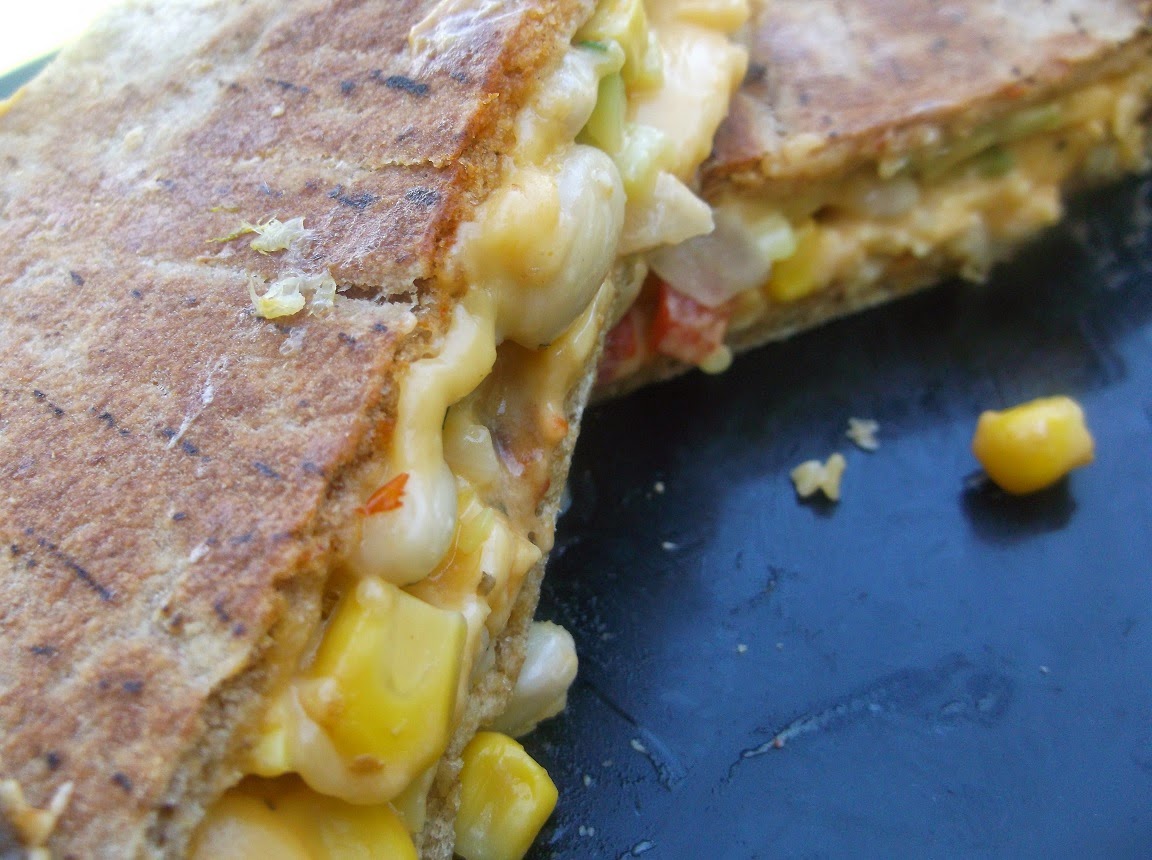
Cheesy Succotash Grill

Want a great and filling grilled cheese sandwich that is truly filling? Here it is, and using Succotash ingredients gives you the satisfaction of protein without the fat. As you know, Succotash has been around for centuries here in New England and many moons before us Europeans coming over. This is, yet again, one of the true, great food gifts bestowed upon us from the Native Americans.

2 small pita breads

Pumpkin Mayonnaise, recipe below
Nonstick cooking spray
1 cup shredded Pepperjack cheese
1 cup whole kernel corn
1/2 small diced tomato
1/4 cup diced onion
1/2 cup cooked great northern beans*
1/2 cup diced, cooked chicken


With a sharp knife, insert it into the pita bread and cut around it to form two thin halves. Repeat with other pita. In a small bowl, mix 1/4 cup mayonnaise with 2 tablespoons pumpkin, 1/2 teaspoon chili powder, 1/4 teaspoon cumin, 1/4 teaspoon salt and black pepper; mix well; set aside. Spray the outer outer half of two pitas and place in a large skillet over medium-low heat. Spread some Pumpkin Mayonnaise and top with equal amounts of half the cheese, corn, tomato, onion, beans and chicken. Sprinkle remainder of the cheese over both and top with the other halves of the pita, with more Pumpkin Mayonnaise spread over each. Cook, flattening down with a spatula, until it is starting to crisp. Carefully flip over to finish crisping on the other side. Remove and enjoy.


*Lima, fava, kidney or cooked pinto beans would be equally delicious


Tempting Jagasse

Not many people know, or even heard, of Jagasse. In the early 1800s, fishermen along the Massachusetts coast were also farmers in their 'non-fishing' time. Of course their families had their fill of fish in meals and this dish gave them a subtle hint of the ocean while enjoying the bounty of the garden as well. They used whole fish in their Jagasse, but just the hint of the ocean is all that is needed in this delicious, original Yankee recipe derived from Succotash.

2 strips bacon, diced
1 cup fish broth or clam juice
1/2 small summer squash, diced*
1/2 small zucchini, diced
1 cup whole kernel corn
1/2 cup red bell pepper, minced
1/4 cup minced onion
1 cup cooked navy beans
2 cups cooked rice
1(15-ounce) can tomato sauce
1 teaspoon garlic powder
1 teaspoon onion powder
1/2 teaspoon red pepper flakes
Salt and black pepper to taste


In a large pot, add the bacon and cook until crispy over medium heat. With the bacon and fat still in pot, add the fish broth. Boil for 3 minutes before adding the squash, zucchini, corn, red bell pepper and onion. Stirring occasionally, cook until the vegetables are just barely tender. Add beans, rice, tomato sauce, garlic and onion powders, red pepper and salt and pepper to taste. Stir to combine and continue cooking until everything is heated through.


Enough for 4 side dishes


Friday, March 14, 2014

Too Late???

I just remembered 2 days ago that St. Patricks Day was a mere few days away and I am in a rush now to offer some tweaked Irish dishes for everyone to enjoy. On my website, theyankeechef.com, I have a great assortment of Irish recipes, but every year I add more and more. That is until this year. I usually start many weeks previous to the celebrations, but with my new time constraint, I am giving you some of my favorite recipes I have had tucked away for just such emergencies. So let's begin here on my blog.

As you will see below, I use stout for an authentic taste of Tipperary. Dry stout is Ireland's claim to beer fame. It is a unique tasting brew, almost black in color, very rich in flavor and has a 'roasty', almost chocolaty flavor. Irish stout is drier than most English brews, with Guiness leading the pack the world over. Murphy's and Beamish, however, are just as popular in the Emerald Isle. Lager is made with pride(such as Harp)and equally enjoyed by the Irish as well and can be used in these recipes easily.

An often overlooked Irish import is cheese. Once you have tasted Irish cheese, readily found in most supermarkets, you will wonder why you still buy other aged Cheddar cheeses. Although our American made Cheddar is a delight in many ways, I have never been able to find the 'bite' that a true Cheddar should have......until I fell in love with Irish cheese


New Irish Mac and Cheese

Irish ham is brined and smoked in such a way that you would be hard pressed to find a comparable tasting ham. I adore Irish ham and it is readily available in most supermarkets no matter where you live, just ask the deli clerk. This Mac and Cheese has great Irish crunch from the roasted, seasoned kale, superior Emerald smoothness with the cheese and it is super simple to make.

1/2 bunch kale

1 teaspoon extra virgin olive oil

1/2 cup grated Parmesan cheese, divided

1-1/2 cups cubed, smoked ham, Irish if possible

1/4 cup plus 2 tablespoons butter or margarine, cubed

1/2 cup Guiness, Murphy's or Beamish stout

2 cups macaroni

1/4 cup flour

2 1/2 cups milk

1/4 teaspoon black pepper

8 ounces Irish Cheddar cheese, shredded

Preheat oven to 350-degrees F. Rinse and dry kale leaves, cutting out the tough, center stalks. Tear them into bite-sized pieces and toss them with the olive oil and 2 tablespoons Parmesan cheese in a bowl. Place them on a pan and bake for about 8-9 minutes, or until crispy, browned but not burnt. Keep an eye on them, some may crisp up faster than others so open oven to remove the crisp ones while continuing to cook remainder. Remove from oven while preparing remainder of recipe. Leave oven on.

In a medium skillet, over medium heat, add the cubed ham and 2 tablespoons butter. Cook ham, stirring frequently, until lightly browned, about 3-4 minutes. Add stout and continue cooking and stirring until liquid has almost entirely evaporated, about another 3-4 minutes. Remove from heat; set aside.

Cook macaroni according to package directions; drain and set aside but do not rinse. In a large saucepan, melt remaining butter over low heat; when melted, whisk in the flour until smooth. Raise heat to medium and add milk and pepper, whisking well. Continue cooking and frequently whisking until thickened, about 2 minutes. Add cheese, whisking until melted; remove from heat. Add the macaroni, ham, remainder Parmesan cheese, stirring to combine. Transfer to a 2-quart baking dish and bake for 25-30 minutes, or until bubbling. Serve with the crispy kale thrown on top of each serving.

Serves 3


Gloriously Easy and Hearty Irish Stew

A hearty recipe that truly harbors the flavor of the Emerald Isle. I could have tweaked this recipe here and altered it there, but why mess with a dish that simply is great the way it is? As many of you know, lamb is my favorite protein so I wasn't about to play with this great, Irish dish.

2 tablespoons vegetable oil

1 pound boneless lamb shoulder, cut into 1-inch cubes

2 carrots, peeled, sliced

1 onion, peeled and diced small

1 rib celery, sliced thin

2 1/2 cups beef both or stock

1(12-ounce bottle) Guiness stout

1 pound potatoes, peeled and cut into 1-inch cubes

2 tablespoons cornstarch blended with 1/4 cup cold water


Heat oil in a large 5-quart pot over medium high heat for a minute. Add half the lamb to lightly brown on all sides, turning frequently, about 7-8 minutes. Transfer to a plate and continue with remaining lamb. Remove that lamb to a plate and add the carrots, onions and celery. Reduce heat to medium and cook about 10 minutes, or until celery is softened. Add lamb back into pot with broth and all stout. Cover and simmer over medium-low heat until meat is tender, about 20 minutes. Remove lid to add potatoes and cook an additional 10 minutes, covered. The potatoes should be just soft when pricked. Stir in the cornstarch slurry,well,and continue cooking until stew has thickened,about another minute or two.

Makes enough for 1 Yankee or Irishman..... 3 servings for everyone else.


Yanked Colcannon Potatoes

Rather than using a quarter of a cabbage while watching the rest of the head shrivel and dry in the fridge, why not buy a bag of shredded green and purple cabbage and carrots and slightly cook them for a great side dish to your Irish table? I personally love the crunch of crisp-tender veggies in my Colocannon, pairing well with just right cooked corned beef. Normally cheese doesn't belong with Colcannon, but I truly believe once you tasted true Irish cheese, you will love it as well.

3 pounds potatoes, peeled and halved

1 teaspoon minced garlic in oil

2 cups bagged coleslaw mix

3 tablespoons butter or margarine

Salt and black pepper to taste

1 cup milk or half-and-half

Cover potatoes with at least three inches of water and cook over medium-high heat until done.

Meanwhile, in a large skillet, add the garlic and butter. Cook over medium-high heat until garlic is fragrant, about 1 minute, stirring frequently. Add the coleslaw mix, stirring well and cook for 3 minutes, tossing frequently, or until slightly tender but with plenty of crunch. Cook longer if you don't desire the vegetables to be crunchy in the mashed potatoes. Reduce heat to low and add milk, salt and pepper to taste. Bring milk to scalding but do not boil and then turn off heat.

Drain potatoes and mash by hand or use a mixer. Fold in the milk/coleslaw mixture until well blended.

Enough for 4-6


Crispy New England-Style Colcannon Cakes

Adding sharp Vermont Cheddar in a recipe from or Yankee counterparts recipe is the perfect compliment to each other. There is something about melted cheese coming from a crispy exterior of a soft, mashed potato pancake. This recipe is geared for leftover potatoes but why not make Colcannon Potatoes ahead of time and grill up these tasty patties for your Irish table?

2 cups leftover Colcannon potatoes

1/2 cup leftover corned beef, chopped

3 tablespoons oil

2 cups cornmeal

1/4 cup shredded Vermont extra-sharp Cheddar cheese

In a large mixing bowl, loosen up(or remash) the potatoes with a masher or fork. Fold in the corned beef and form into four 1/2-cup measure balls. Make an indent in each to fill with a tablespoon(or more if you prefer) cheese. Close the gap and flatten out to an inch in thickness. Place in refrigerator for 30 minutes.

Meanwhile, heat oil in a large skillet over medium heat, nonstick pans are best. Place the cornmeal in a shallow plate. Remove potatoes from fridge and dredge both sides of each potato patty with cornmeal, pressing firmly. when oil is hot, add the Colcannon Cakes and cook for 4-5 minutes per side, or until well browned. Remove and serve.

.

Simple Shillelagh Pots

These "custards" are as smooth as the meadows of County Mallow with just the right amount of Irish flavor. This is one of those desserts that I feel needs no adornment, such as whipped topping, but if you desire, whip some up, blending some more Irish liqueur into the whipped cream for a more festive, green accent.

8 egg yolks

1/3 cup sugar

2 cups milk

1/3 cup Irish cream liqueur

Ground nutmeg or cinnamon

4 cups hot water

Preheat oven to 325-degrees F. In a saucepan, heat the milk over medium-low heat until it is just simmering, stirring frequently. Immediately remove from heat. Meanwhile, whisk together the yolks and sugar in a bowl until as smooth as possible. Whisk a half cup of the hot milk into the yolk mixture and then whisk all of the tempered yolk mixture into the pot of milk. Whisk well along with the liqueur.

Evenly pour mixture into six 4-ounce ramekins or bake-safe serving cups. Sprinkle each with nutmeg and place in a large baking dish with sides at least 2 inches high. Pour hot water so that it comes up about halfway up the sides of cups. Bake for 35-37 minutes, or until the centers are just set. Remove from oven and water bath to cool completely in refrigerator at least 3 hours or until completely set.

Saturday, January 11, 2014

Boston Brown Bread(or New England Brown Bread)

The story and beginnings of this deliciously sweet brown bread is simple and confusing at the same time. Many historians will have you believe that it evolved from the basic "Thirdings"(see below) while others will tell you it all started with "Rye and Injun".

There is also speculation as to why Brown Bread, which started out, they say, as a bland and unsweetened bread ended up being flavored with molasses and/or maple syrup as time progressed.

There is also confusion as to why this bread was initially made with wheat and later substituted with rye. Just to clear the air(and I realize this is kind of boring to most of you but being somewhat of a 'square' according to my kids)I love this type of thing. Besides, I wouldn't be much of a New England Food Historian if I didn't have the answer now would I? Besides, I am going to give you the best Boston Brown Bread recipe you will ever taste, if you don't mind sitting through some of the red tape first.


                                                         Courtesy of rioldhouse.net
 
As everyone knows, steamed puddings and breads have been around many centuries before our forefathers landed on New England soil. Although many early Puritan fireplaces had some type of oven built into the back or side walls, baked goods were generally cooked in or around the fire, either the dough laying directly on the stone floor in front of the fire or on top of discarded leaves of cabbage or large tree leaves. It wasn't until a generation or two after the first immigrants arrived that separate ovens were built inside these huge fireplaces. These were simply a dome shaped "hole" that a separate fire was built. Once the 'oven' became hot enough, the ashes and embers were swept out with some turkey feathers and baked goods were placed inside to bake.

In the meantime, reflector ovens, spiders and Dutch ovens were the necessary vogue for preparing anything you didn't want stewed. As for steaming bread, well this wasn't common for quite some time after colonization. Brown bread was always baked during the early years. Rye and Injun being the precursor of our Boston Brown Bread. Containing wheat or rye flour, a pinch from the previous unbaked loaf of bread, "injun" or Indian meal(cornmeal) and some hot water, this bland bread was then cooked near the fire until done. As time eased on, a sweetener was added, most always molasses because of its' necessity in any Puritan and colonial kitchen, especially if your lived near Boston. Some households used just rye flour, others stuck with wheat while many families used a combination of both.

In the early cookbooks and references, this recipe was referred to as Thirdings" because it used a third amount of cornmeal, a third rye flour and a third wheat flour. White flour as we know today simply was not used during this period in New England. Many food historians will also tell you that because of the outbreak of stem(or wheat) rust during the last years of the 1660s, wheat was replaced by rye in Boston Brown Bread. While we did have an issue with this rust, it was contained for the most part along the coastal areas of Connecticut. While it is also true that many farmers gave up on growing wheat because of this rust, it was not wide spread enough to effect bread recipes in the rest of New England. While wheat was a significant harvest during the very early years o9f colonization, its use became more and more less demanding, rye becoming the staple.

Now back to our bread. John Winthrop, Jr., writing in 1662, just a few years before wheat's declination:

"There is...very good Bread made of [Indian corn], by mixing half, or a third parte, more or less of Ry, or Wheate-Meale, or Flower amongst it, and then they make it up into Loaves, adding Leaven or yeast to it to make it Rise."...


Over time, soured milk was added to the recipe, along with maple syrup or molasses, depending on your location. Boston, being the hub of international shipments, was the birthplace of adding molasses, reaching out to the hinterlands from there. As with baked beans, which is the classic accompaniment of brown bread, New Hampshire and Vermont chose to use maple syrup in both recipes more often than not.

The earliest recipe I find for Brown Bread is in Lydia Child's cookbook, American Frugal Housewife, 1830. I love it with butter slathered on both sides and grilled. Eat as is or as many historians will have you begging to do, enjoy it with homemade baked beans. And yes, I have a great recipe for authentic New England Baked Beans on my site, theyankeechef.com.

Raisins were not added for many, many generations after and this author finds them to be the perfect addition, but not necessary for those of you who wish to exclude them. Boston, or as some refer New England, Brown Bread is great cold, slathered

FYI: My ancestor, Deacon James Bayley of Salem, Mass., tells of a drink that was widely popular during the late 17th and early 18th century in his hometown. It was called "Whistle Belly Vengeance". Made with soured beer that was boiling, he added molasses and a handful of brown bread crumbs. Served up nice and hot, it was(apparently) good for what ailed ya' in the cold, winter New England months.

There are several ways of easily steaming Boston Brown Bread. In the oven, stove top or using a crockpot. Although I enjoy the stovetop method, I don't use it often because of minor children running around the house during the cooking time, which is anywhere from one hour to two. I much prefer the oven method or even better, the crockpot. many recipe will have you using an empty coffee can as well. Although some coffee cans will not have that ridge on each end of the can, I find that many do, and it is expressly difficult to unmold your brown bread when that is present. I prefer a 26-30-ounce large soup can. Although they have ridges, they are much MUCH smaller and don't interfere in the least bit with unmolding. As long as the can holds about 3 cups, you are good to go. Always remember to remove any label first before cooking.

The Yankee Chef's Boston Brown Bread

There are variations to Brown Bread including using 1/2 cup molasses and 1/2 cup of maple syrup. Beware that the dough will not be as dark though. You can also use white flour in place of wheat if desired, but again, it won't be as dark. If you don't want to purchase more rye and wheat flour than you will use, simply buy what you need at a health food store.


1/2 cup raisins

1 cup boiling water or apple juice

1 cup whole wheat flour

1 cup rye flour

1 cup yellow cornmeal

2 tablespoons brown sugar

1 teaspoon salt

1/2 teaspoon allspice, optional

2 teaspoons baking soda

1/2 cup molasses, warmed

2 cups buttermilk or soured milk *

2(26-28-ounce) empty cans with top and bottom removed

Tin foil

String


In a small bowl, combine boiling water and raisins and let sit for at least a half hour while preparing recipe.

Preheat oven to 350-degrees F. Spray the inside of both cans with nonstick cooking spray liberally. Set aside.

In a large bowl, combine flours, cornmeal, brown sugar, salt, allspice and baking soda. In another add the molasses and cover. Microwave on high for 10-15 seconds or until warmed through. Remove from microwave and add to a bowl containing buttermilk, stirring well. Drain raisins and stir into molasses mixture. Add molasses mixture into flour mixture and combine until well incorporated. This doesn't have to be smooth but it does need to be well mixed.

Cover one end of each coffee can with tin foil and tightly tie with string. Place each can(tin foil side down) into a large pot that is oven proof and sides that are at least as high as the cans. Equally divide brown bread batter into each can, no more than 2/3-full. Fill pot with boiling water, enough to come up at least one third of the way up.

Place in oven and steam in oven for 1 hour and 15 minutes to one hour and 30 minutes or until toothpick inserted in the middle comes out fairly clean. It won't come out perfectly clean because this is a steamed bread. Remove from oven carefully and remove from water bath. Cool at least 30 minutes before removing foil and pushing bread out from can to cool completely.

For the crockpot, make sure the water comes up the same amount and the lid fits snugly. On low, simmer the bread anywhere from 2-3 hours, testing as directed above.


* Stir in 2 teaspoons lemon juice or cider vinegar to 2 cups whole milk. Let stand for at least one hour in a warm kitchen or in oven that is not heated. Let milk curdle and sour before adding.

Wednesday, December 18, 2013

Only At Christmas


Although these recipes would be great during all the colder months(and maybe during the warm temperatures as well), they are great additions to your Holiday table or even as gifts for family and friends to take with them once they have finished and are ready to roll out.


Sugar Plum Jelly

Many of you may have the powdered form of pectin already in your pantry. And YES, you can substitute one for the other. Liquid pectin is used in preserve, jam and jelly recipes that require cooking first while powdered pectin can be used in the same recipes, even if you aren't cooking them. One tablespoon liquid equals 2 teaspoons powdered.

In the recipes below, each pouch is 3-ounces, or 1/4-cup powdered if using. Double this in the following recipe. While Certo brand liquid pectin comes in 6-ounce pouches, Sure Jell comes in 3-ounce pouches. I also use the pink box at times, which is called "Sure Jell Liquid Pectin for Less". This means that the pectin will set up with less sugar and no sugar commonly found in most jams, jellies and preserves. Use dry as you would wet pectin.


2 cups plum juice(Sunsweet brand makes a great one)

3/4 cup sugar

Juice of one large orange, strained

1 teaspoon grated orange zest

2(3-oz)pouches liquid pectin*


In a food processor or blender, add the plums and apple juice. Pulse until plums are minced but still have small chunks throughout, about 10-15 seconds. In a large saucepan, bring plum/juice mixture, sugar, orange juice and grated orange zest to a boil over high heat, stirring almost constantly. . Stir in the pectin and boil for 1 minute, stirring constantly. Remove from the heat and pour into four half-pint jars. Seal with lids and refrigerate 6 hours, or longer, until set. I don't care for the uneasy spreadability of jelly so I always mix it up before using.
This is fantastic on any fruited quick bread or coffee cake, toast, English muffins or just plain ol' crackers.


Figgy Pudding Preserves

Although this recipe contains no figs, I substituted raisins. Many recipes call for this substitution in Figgy Pudding and if you want to stay true to the classic, use 1/2 pound fresh figs, trimming off both ends first before adding to food processor. Add, also, 1 tablespoon lemon juice. If using dried figs, boil 6 ounces in apple juice for 10 minutes, over medium heat, until starting to soften and plump. Remove from heat and let sit in hot juice for 1 hour. Add this to the food processor with candied ginger, cinnamon and nutmeg. Continue with recipe.

For a great, warm and homey taste and feel of "Yankeeville" during the Holidays, spread some of this comfort preserve on absolutely anything you desire.
 

2 cups apple juice

1 1/2 cup raisins

2 ounces candied(or crystallized) ginger

1/2 teaspoon cinnamon

1/2 teaspoon nutmeg

2(3-ounce)pouches liquid pectin

In a food processor or blender, pulse first 5 ingredients until ginger and raisins are pulp-like in size, about 1 minute. Remove to a large saucepan and bring to a boil over high heat. Stir in the pectin and cook for 1 minute longer, stirring constantly. Remove from heat and carefully ladle the jelly into four half-pint jars, leaving a half-inch space on top. Seal with lid and refrigerate until set, about 6 hours or longer.
Once this is set(as I do the Sugar Plum Jelly) I take a fork and mix it up a little so the raisins that may have settled on bottom while hot is mixed throughout evenly.

Wednesday, September 18, 2013

Taking a Breather


   I have been so busy with my second book, judging, appearances and book signings, I have been neglecting one of my only solace-rendering past-times.....reading. So I grabbed some very old manuscripts, recipes, stories and notes that my father had written before he died and I started reading them. Then I began to think that I should add some old time dishes that our grandparents, great grandparents and ancestors used to subside on and put them online so that they will never be forgotten.
   Some of us calm our nerves and relax by watching television while others take a walk or simply sit and think. I(like my father) love to "remember when...". Even though I don't personally remember these dishes, I have made them time and time again(I truly was meant to have been born many generations ago)
    I do love to think of how my parentage were huddled in their crude cabins in the middle of Bailey Hill with only the fire from the hearth casting its illumination. I love pondering how meals must have been so comforting and satisfyingly odoriferous. Granted we would snub our noses at homemade, real butter now and using leaf or hogs lard is a serious 'no-no' now, but the flavors and aromas of real food surely calmed the rowdy children and soothed the savage husband.
   Let me give you a few old-time dishes you may or may not have heard of. Food that was the energy giver for those hard working folks. People who didn't need to exercise to stay fit, but whose exercise was their daily chores and necessities of living.

Ambrosia, ca 17th century-mid-19th century. When we think of the word ambrosia today, some type of fruit salad mixed with a dairy product and topped with coconut comes to mind. Back a few generations, ambrosia(literally meaning food of the Gods) was simply corn. Generally it was the dried and milled corn that was deemed such.
   Hasty Pudding was made with dried corn(henceforth referred to as cornmeal). And although many of us have heard of Hasty or Indian Pudding, not so many knew that it was an absolute sin for it to be the least bit lumpy. My father used to say that it was originally made with milk and eggs and a "trifle of Muscovado sugar or Portorique molasses". Brown sugar sauce was generally made to top it off, which was just melted brown sugar.
   Back in the day, Indian pudding wasn't the insipid recipe many chefs use today, but nicely stirred, well-boiled without any two particles sticking together. People, also, don't know to to classically enjoy this dish as well. A spoon should be dipped into milk before it lifts the pudding to the mouth. This keeps it from sticking not only to the spoon, but to the inside of your mouth. It was meant to be enjoyed one spoonful at a time, each bite completely separated from the next.
   And do you think the Italians were the first to enjoy polenta? No, no, no, no! Eating hot Indian or Hasty Pudding was just as often seen in our homesteads of old as was cutting it when cold and grilling it in lard the next day. It is often written that when fried in fresh butter of cows who only ate clover, this meal was fit for a king.

Milk Porridge, ca 17th century-late 19th century. First water was boiled. Cornmeal was then added through ones fingers(acting as a type of coarse strainer) and the other hand was gripping a wooden paddle, stirring as the cornmeal was added to the water. When the corn was added, and the lot stirred for a time, fresh milk directly from the cow was very slowly added. It is said that you should not add the milk until you could see your nose reflecting off the surface of the cornmeal/water mixture.

Corn Biscuit, ca 18th century-late 19th century. This was an Indian luxury, and was made with one pound of butter, one pound of sugar, ten eggs and a pint of new milk, with just enough cornmeal to mold it into thin cakes. Sound familiar? It is now known as Pound Cake!

Whitpot, ?-mid-18th century. A very thin Indian Pudding, baked in a very slow oven(low temp) so that the milk, eggs and molasses formed a jelly throughout the entire pudding.

Herring Sticks, ?-late 19th century. From mid-May to mid-June, the herring run was on in all of New England in days gone by. Many old texts referred to Cape Cod herring as an alewife. Often called a "poor mans fish", it was freely gifted each year by the town to each child born within the township limits. Many townships actually enacted legislation ordering just such a gift!
  The herring was so plentiful that townships were not able to eat or locally sell them, so they were shipped to larger cities. One older lady, in her journal from New Hampshire, relates "I do relish a nice fresh herring with my breakfast".
   Salting and smoking was the norm to help keep a family fed through the lean months. Before salting or smoking, however, they were strung on sticks. The sticks were for the most part whittled from cedar, stripped from the old cedar, split rail fences everyone had around their property. The cedar sticks were passed through the gills of the fish with a dozen or so strung on each. On many New England roads, the lettered signs on the fences used to read, "Herring  10 cents a stick".

Lobster Stew. Now of course many, if not all, of us have heard of Lobster Stew, but would you like to know how to truly make it the old-fashioned way? The correct way? A little trivia first. Lobster Stew was almost always accompanied with a couple of sour pickles.
   Begin with the tomalley. Saute it in an equal amount of butter in a thick cast iron skillet for 5  minutes. Add the cooked and picked lobster meat and every bit of juice that came from the cooked lobster as you were shelling it. The ratio between lobster meat and juice should be about 50-50. You don't ever, EVER, add salt or pepper to lobster stew! Old cooks and housewives used to relate that lobsters got plenty of salt and seasoning from the ocean it lived in. I tend to agree!!
   Leave this stew on a hot fire for 5 minutes, then push it back to a cooler part of the stove to come down from boiling to a bare simmer for about 15 minutes. While still barely simmering, slowly(and they did mean SLOWLY) add your milk. Housewives say to "trickle" the milk into the stew, while constantly stirring. Add  rich cream after the milk has been added. When the stew blossoms out suddenly into a rich salmon pink under your spoon, you can know that the stew has been made properly and is now to remove from all heat sources and let cool for a hours . My father used to say that cooling the stew was just as important as making it. The flavor increases drastically. True lobster stew wasn't meant to be consumed when it is made, but rather cooled for many hours then reheated to enjoy.  As if.....

Muslin Toast, 18th century-mid-19th century. This was a favorite supper dish of many Yankee families. Now remember that dinner(or the noontime meal) was the heartiest of all repasts during the day, while supper was just enough food to hold you over until the table was laden for breakfast. Muslin Toast was a type of rye shortcake, the size of the skillet, that was grilled in sweet homemade butter on each side until very crispy. As each side was crispy, it was cut off and set aside. This was repeated until you had about 7-8 thinly crisped slivers of shortcake, with the last slice being grilled. All these crispy slices were then placed in a bowl of hot, thickened and salted milk.


My how times and appetites have changed. I loved looking back and I think I will continue this post within the next few days.