Showing posts with label beans. Show all posts

Saturday, January 6, 2018

BEANO!!

  I bet many of you remember shouting that word out during a childhood game of the same name, and to be rewarded with a kewpie doll. Well then again, maybe not. I remember the game but not the doll, as the name of the game now called Bingo. Beano was a popular board game for many years, starting in the first quarter of the 20th century in an undetermined Southern state. It was played basically the same way as Bingo is today, but one would place a dried bean on the number called and when they had completed a complete line of numbers either vertically, horizontally or diagonally, they would win. 


  The name Bingo was inadvertently shouted late one night instead of Beano, and there you have the rather dull beginnings of this time honored game. 

  Beans also are considered rather a dull protein-packed meal as well. They are also time-honored and for good reason. Beans were a lifesaver to our ancestors who came over to this new land in the 17th century. Many were given huge lots of land simply for coming over and settling. And beans, along with pumpkin and corn, were grown by everyone because they could grow in the rockiest of soils and were cheap. 

  Beans were more often than not the center of a Puritan meal, with meat as a side dish. So throughout the ages, beans of ever kind have held a true comforting appeal to many, as well as this chef.

  Find below 3 recipes that are not your usual take on the bean, but still a comforting taste whose protein quickly fills and warms you up.


Spicy Charro Beans 


  Literally meaning Cowboy, Charro is usually served as a soup, or with a soup-like consistency, but I find this recipe perfect the way it is. Charro beans are loved by all Mexican 'horsemen' and you will see why with one flavorful bite. 

1/4 pound bacon, diced
1/4 pound Chorizo sausage, diced
1/2 small onion, minced
2(15-ounce)cans pinto beans, drained and rinsed
1(7-ounce) can chipotle peppers in adobo sauce
2 tablespoons molasses
1/2 cup your favorite salsa
2 teaspoons chili powder
1/2 cup whole kernel corn
4 cups hot cooked rice, if desired.

In a large saucepan, over medium heat, add the bacon, chorizo and onion. Stir to combine and cook until the onion is softened and the bacon has cooked to your liking. Drain fat and add remainder of ingredients except rice. Continue to cook and stir until heated through. Serve hot as is or over rice.


Cheesy Italian Baked Beans 
A tasty Italian rendition to the Baked Beans we enjoy in New England, but taking a fraction of the time to prepare. Although the Native Americans in New England used corn as a support-base for growing the common bean(as part of the Three Sisters), in Italy the Romano bean was used in their version of the Three Sisters. This fiber-rich bean are most often found in Minestrone soups, fagioli dishes and poultry cooked in the style of all'uccelletto. It is one of the few hearty bean varieties that pair perfectly with pungent and bold Mediterranean spices, such as listed below.


2 tablespoons olive oil
1 teaspoon crushed garlic in oil
1/2 onion, minced
1(28-ounce)can diced tomatoes with green chilies, undrained
1/2 teaspoon each dried rosemary, basil and oregano
3(16-ounce)cans Romano beans, drained well*
1 cup shredded Parmesan cheese
1/2 cup shredded, smoked provolone cheese
1/2 teaspoon red pepper flakes
Salt and black pepper to taste

Preheat oven to 400-degrees F. In a large saucepan, heat oil over medium high heat until shimmering hot. Add garlic and stir well while cooking for 1 minute. Add onion, continuing to cook and stir until onions are tender, about 3 minutes. Add tomatoes and herbs, stirring well. Bring to a boil and then reduce heat to medium.
Cook 8-10 minutes, or until the liquid is starting to reduce and thicken. Add beans, half of both cheeses, red pepper flakes and salt and pepper, stirring to combine.
Transfer contents of pan to a 2-quart baking or casserole dish, top with remaining cheese and bake until all cheese is melted and the entire dish is bubbling. Remove from oven to serve hot.

* Or use cannellini beans if desired.  

Makes 4(1 1/2-cup) servings


Savory Pork Stew with Sweet Potatoes

So thick you can actually eat this winter time bowl of goodness with a fork. White potatoes or even that leftover pie pumpkin works easily here as well. I don't pretend this is a gourmet meal, nor do I tout this simple recipe as something that will garner accolades around the globe. But it is a comforting dish of piping hot, warm your belly kind of meal that the kids will enjoy as well.

1 tablespoon olive oil
1 pound boneless pork loin, cut into 1/2-inch pieces
1 small onion, minced
1 small bell pepper, seeded and minced
1 teaspoon rubbed sage
1 teaspoon each salt and black pepper
1(28-ounce can) diced tomatoes with green chilies, undrained
2 cups chicken broth
3 cups diced, raw sweet potato
1 1/2 cups frozen corn
Juice from 1 orange and 2 teaspoons grated rind
4 cups cooked pasta or noodles of your choice, kept warm


Heat oil in a large saucepan over medium high heat. When hot, add pork, onion and bell peppers, stirring well. Cook and stir until pork is cooked through, about 5 minutes. Add remainder of ingredients, stirring well. Bring to a boil, reduce heat to low and simmer for about 30 minutes, uncovered, or until potato is tender and  pork is cooked through. Stir a few times. This will make a very thick stew so for thinner, simply cover before simmering.
Makes about 4 good-sized servings

Wednesday, August 20, 2014

Sufferin' Succotash

Ever give it much thought when Sylvester blurted out that phrase whenever he didn't get his way?

There has been so much written about Succotash and, as in genealogy, there is a lot of half truths. While many "authorities" say that Succotash comes from the Algonquin misckquatash, I don't believe that to be the case. See my article on corn at theyankeechef.com.

In the meantime, Succotash is a great, original American Indian dish that our fore-families have enjoyed for centuries. This dish is made mostly during the Holiday times of year, which is not understood by me. It was eaten at all times of the year, whether it was when the corn was ripe to eat or in the middle of winter when they had to use their dried corn and beans.

Although fava and lima beans were the original beans used for this dish, I have substituted Great Northern, only because my kids won't touch either one of the other two. Clabbard, or Clapboard, beans were used during the 18th and 19th centuries more often than not as well.

I have also used a variety of vegetables in this Yankee staple too, but have omitted any protein, although the Indians and colonists used whatever meat or fish they had on hand. Succotash is great by itself as a side dish or as a base for meat or fish. It is as tasty as it is colorful.

Enjoy these three recipes that highlight our heritage and simplicity as well as being the original colony of comfort foods, the New England colony.


Creamy New England Succotash

Without going into a long spiel about the beginnings of Succotash and variations over the years, I will simply tell you this is probably as good of a true Yankee dish as you are going to enjoy. True Succotash used chicken, pork or whatever protein the family had and cooked it with beans, corn and onion. They would then add some milk to the pot and let it get a little thick before serving it to their family. I have added some more vegetables but have kept the true recipe intact. I think you will enjoy this trip back in time, with a modern approach.

3 strips bacon, diced
1 small summer squash, diced*
1 small zucchini, diced
1/2 cup red bell pepper, minced
1/4 cup minced onion
2 cups milk
1/2 cup sour cream
1 1/2 cups whole kernel corn
1 cup cooked navy beans
Salt and pepper to taste

In a large skillet or pot, cook bacon over medium heat until crispy. Leaving the bacon and fat in the pan, add the squash, zucchini, bell pepper and onion. Stirring occasionally, cook until vegetables are crisp tender. In a bowl, whisk together the milk and sour cream until well incorporated; set aside.

Add the corn, beans and milk mixture and salt and pepper to taste. continue cooking, stirring occasionally still, until everything is heated through and most of the liquid has been absorbed, another 5-7 minutes.

*or use zucchini or a combination of each


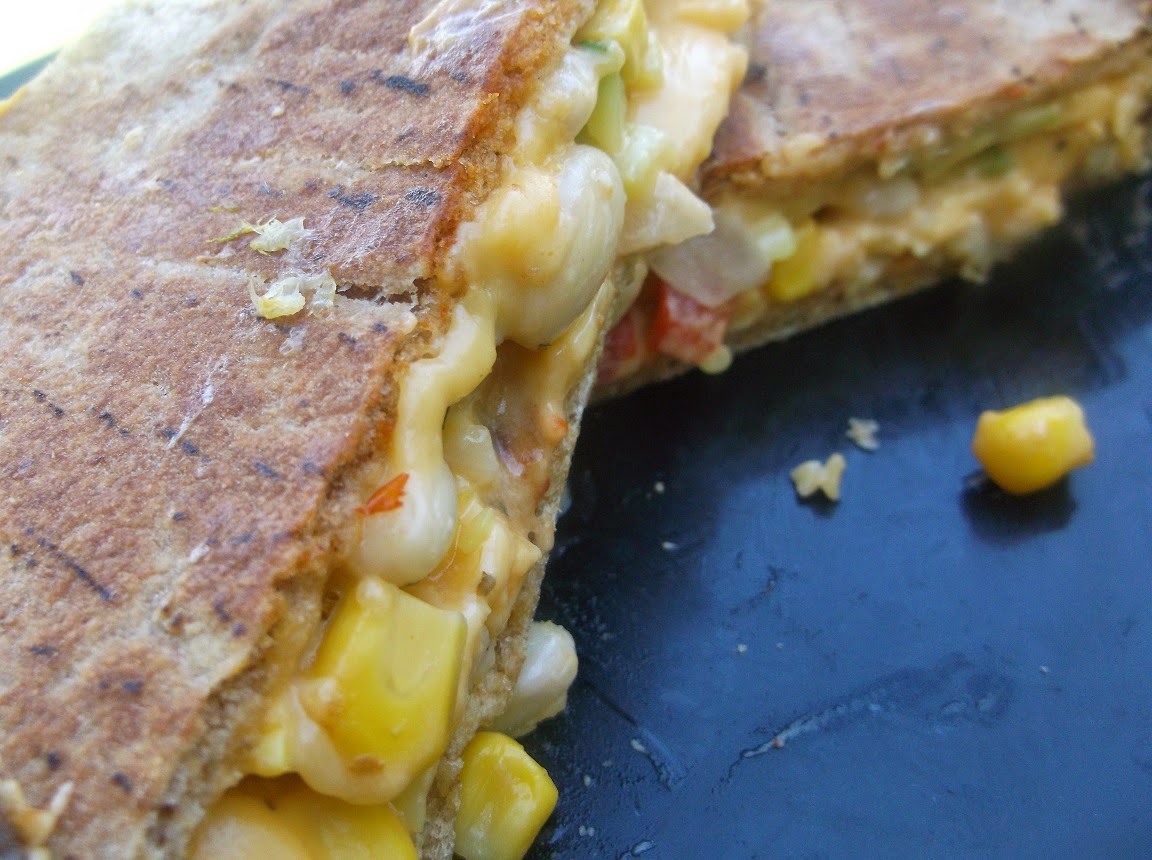
Cheesy Succotash Grill

Want a great and filling grilled cheese sandwich that is truly filling? Here it is, and using Succotash ingredients gives you the satisfaction of protein without the fat. As you know, Succotash has been around for centuries here in New England and many moons before us Europeans coming over. This is, yet again, one of the true, great food gifts bestowed upon us from the Native Americans.

2 small pita breads

Pumpkin Mayonnaise, recipe below
Nonstick cooking spray
1 cup shredded Pepperjack cheese
1 cup whole kernel corn
1/2 small diced tomato
1/4 cup diced onion
1/2 cup cooked great northern beans*
1/2 cup diced, cooked chicken


With a sharp knife, insert it into the pita bread and cut around it to form two thin halves. Repeat with other pita. In a small bowl, mix 1/4 cup mayonnaise with 2 tablespoons pumpkin, 1/2 teaspoon chili powder, 1/4 teaspoon cumin, 1/4 teaspoon salt and black pepper; mix well; set aside. Spray the outer outer half of two pitas and place in a large skillet over medium-low heat. Spread some Pumpkin Mayonnaise and top with equal amounts of half the cheese, corn, tomato, onion, beans and chicken. Sprinkle remainder of the cheese over both and top with the other halves of the pita, with more Pumpkin Mayonnaise spread over each. Cook, flattening down with a spatula, until it is starting to crisp. Carefully flip over to finish crisping on the other side. Remove and enjoy.


*Lima, fava, kidney or cooked pinto beans would be equally delicious


Tempting Jagasse

Not many people know, or even heard, of Jagasse. In the early 1800s, fishermen along the Massachusetts coast were also farmers in their 'non-fishing' time. Of course their families had their fill of fish in meals and this dish gave them a subtle hint of the ocean while enjoying the bounty of the garden as well. They used whole fish in their Jagasse, but just the hint of the ocean is all that is needed in this delicious, original Yankee recipe derived from Succotash.

2 strips bacon, diced
1 cup fish broth or clam juice
1/2 small summer squash, diced*
1/2 small zucchini, diced
1 cup whole kernel corn
1/2 cup red bell pepper, minced
1/4 cup minced onion
1 cup cooked navy beans
2 cups cooked rice
1(15-ounce) can tomato sauce
1 teaspoon garlic powder
1 teaspoon onion powder
1/2 teaspoon red pepper flakes
Salt and black pepper to taste


In a large pot, add the bacon and cook until crispy over medium heat. With the bacon and fat still in pot, add the fish broth. Boil for 3 minutes before adding the squash, zucchini, corn, red bell pepper and onion. Stirring occasionally, cook until the vegetables are just barely tender. Add beans, rice, tomato sauce, garlic and onion powders, red pepper and salt and pepper to taste. Stir to combine and continue cooking until everything is heated through.


Enough for 4 side dishes


Tuesday, April 2, 2013

New England Baked Beans-Better Late Than Never

I realize winter is about over and autumn is a stretch away, but beans beans, that magical fruit has been on my mind all winter and I have yet to make them until now.


From the lumber camps of old to the family breakfast of the affluent, baked beans have graced our homes for centuries. It is quite simply one of the most perfect meals, from an economic standpoint to the "filling" aspect. The earliest mention of baked beans in my family was in the fall of 1786, when a certain Patrick Campbell canoed up the St. Croix River in Maine with an "Indian escort". It began to rain while on their trip, so the two of them, along with Patrick's pet dog, "beached" their canoe under a "sprawling birch tree" and sheltered themselves for a spell. Looking around when the rain let up somewhat, Patrick spotted a foot path. He inquired of his guide where it led, and his Native American friend mentioned that it led to the only settler in District 7(later Baileyville, Maine) by the name of Baillie. This was the phonetic spelling of Bailey used by the Scotsman Campbell.
To make a long story short, Patrick wrote in his diary that this Baillie was a man "of industry with a garden of great magnitude. We dined on baked beans and a small parcel of pork which was not enough to feed his family and myself".

There are many different favorite recipes for Baked Beans that have been handed down from one generation to the other but believe it or not, I would say over half of today's population of the younger crowd have no idea how to bake beans, let alone what seasonings and ingredients go in it or even what type of bean to use. Allow me to give just a quick lesson in New England Baked Beans and offer a few different recipes for you to choose.

Let's start with the dried beans. Firstly, let me tell you emphatically that you should never, NEVER boil beans, either to parboil or while cooking! You will always end up with mush and that is just plain uninviting.
Now the preparation of soaking. What does soaking beans overnight do? Simply put, it shortens the cooking time as well as helps to retain the nutrients and proteins so that the food value of the beans are maximized. Soaking beans, simply put, does NOT reduce these nutrients within the bean.
An old wives tale stating that soaking helps or eliminates the gas so often associated with baked beans is technically untrue. Certainly soaking does help to remove the oligosaccharides(indigestible complex sugars) but the association of these sugars and flatulence is a very thin veil indeed.
And one more substantial benefit of soaking beans would be to remove any dirt particles. Beans are a dirty lot and although machinery of today threshes and sifts the beans, they are not washed at the factory because moisture promotes mold, which in turn causes sprouting. Not to sound nasty but soaking also removes insect larva, rodent contamination, fertilizer or pesticide residues as well.

Types of beans one uses in New England Baked Beans vary as do the preparation methods. In order to truly stay authentically Yankee, yellow-eyes are the way to go. Now although I do love the meaty yellow-eyes, I have a favorite.

Yellow Eye Beans


Navy(Pea) Beans

That would be either the Navy bean or the Great Northern. Unlike the "brown eye" found in yellow eyes, these two beans are minus the discoloration, being pure white. Navy(Pea)beans are slightly smaller and more oval shaped than the Great Northern and are generally associated with Boston Baked Beans. Other than those two differences, the choice is yours. Jacob's Cattle has been a favorite among many Downeast families as well but good luck finding these dried beans.


Regionally, Baked Beans have their own distinctive flavorings as well. In New Hampshire and Vermont, maple syrup is the choice for sweetening your crock, as opposed to molasses in other regions of New England. Brown sugar, onion and dry mustard is universal when it comes to adding even more flavor but the choice between protein differs. Some families prefer bacon over salt pork while others are more contemporary, using flavored sausages, ham and other meats to "bulk" the old Saturday night supper. Find below the traditional Baked Bean supp-er as well as a Yanked version that I absolutely love, sorry Dad!

What to serve with Baked Beans? Brown bread of course. But if you find this New England sweet bread hard to find, just grab yourself a loaf of your favorite bread(even store bought sliced) and start dipping! A great slab of grilled ham is always welcome, kept warm by the brown succulent liquid floating around you plate.

Classic New England Baked Beans
This recipe has not changed in over 80 years, being first served at the Bangor House(in Bangor, Maine) since the early 30s. My grandfather and father, the first and second Yankee Chefs, never deviated from this recipe. Why not? Because why fix something that isn't broken?


1 pound yellow eye beans
1/4 pound salt pork
1/3 cup molasses
2 teaspoons salt
1/4 teaspoon black pepper
1 teaspoon dry mustard
1 whole onion, peeled
3/4 cup brown sugar

Put beans in a large pot and cover with at least 3 inches of cold water. Let soak 12 hours or overnight. When ready to cook, preheat oven to 250-degrees F. Place the beans in a 4 quart Dutch oven or large pot with tight fitting lid. Fill with enough water to cover beans by 3 inches. With a sharp knife, score the fat portion of the salt pork and add the remainder of ingredients, stir well and cover. Place in oven and simply let cook for at least4 hours. Check every hour and stir to make sure the beans haven't dried out.If you find the beans to be getting hard and the liquid has evaporated, add enough water until just level with the beans.
After the allotted time, remove from oven and test to make sure the beans are tender and the liquid has turned into a thick, aromatic broth. Enjoy!


My YANKED New England Baked Beans
About Ten 1-cup servings

1 pound Navy(Pea) beans
1/3 cup molasses
2 onions, peeled and halved
1/2 pound hot Italian sausage, casing removed
1/2 teaspoon black pepper
1/2 cup brown sugar
1 teaspoon dry mustard
1 teaspoon salt
1 teaspoon celery seed
1 ounce dark rum, optional


Put beans in a large pot and cover with at least 3 inches of cold water. Let soak 12 hours or overnight. When ready to cook, preheat oven to 250-degrees F. Place the beans in a 4 quart Dutch oven or large pot with tight fitting lid. Fill with enough water to cover beans by 3 inches. Crush the sausage and add with the remainder of ingredients(leaving a half onion out), except rum, stir well and cover. Place in oven and simply let cook for at least 4 hours. Check every hour and stir to make sure the beans haven't dried out.If you find the beans to be getting hard and the liquid has evaporated, add enough water until just level with the beans. when there is one hour left, add the rum, stirring well.
After the allotted time, remove from oven and test to make sure the beans are tender and the liquid has turned into a thick, aromatic broth. top with the other half of the onion that has been minced before serving. Enjoy!

Many of you reading this post will remember that age old recipe using maple syrup in Baked Beans. The substitution of maple syrup in lieu of molasses in still truly authentic New England cuisine, and may be exchanged with the same measurements.
And as you are comparing my recipe with those on line, you will often see many baked bean recipes using pork belly instead of salt pork. Want to know the major difference between the two? NOTHING!


Can anyone tell me if this is bacon, salt pork or pork belly?
Answer?! All of the above, It's Just That Simple!

If you would rather cook your beans in a crock pot instead of running your oven for such a length of time, by all means do so. Simply cover and cook on a low setting for about 6 hours, or until tender.


Bean-hole Beans
This has been a New England staple since records were kept, and definitely much longer. In wood camps of old, bean-hole beans were served at least once a day and were cooked in the ground. When an appropriate hole was dug, wood was burned until only the embers were left. The pot of beans, lid tightly closed, were set atop of these embers and the dirt was shoveled back on top. It was left to cook from morning till suppertime, when a long pole was "sewn" into the handle of the pot once dug out, and lifted out. There plainly is no substitute for bean hole beans, according to all three Yankee Chefs.