Showing posts with label corn. Show all posts

Wednesday, August 20, 2014

Sufferin' Succotash

Ever give it much thought when Sylvester blurted out that phrase whenever he didn't get his way?

There has been so much written about Succotash and, as in genealogy, there is a lot of half truths. While many "authorities" say that Succotash comes from the Algonquin misckquatash, I don't believe that to be the case. See my article on corn at theyankeechef.com.

In the meantime, Succotash is a great, original American Indian dish that our fore-families have enjoyed for centuries. This dish is made mostly during the Holiday times of year, which is not understood by me. It was eaten at all times of the year, whether it was when the corn was ripe to eat or in the middle of winter when they had to use their dried corn and beans.

Although fava and lima beans were the original beans used for this dish, I have substituted Great Northern, only because my kids won't touch either one of the other two. Clabbard, or Clapboard, beans were used during the 18th and 19th centuries more often than not as well.

I have also used a variety of vegetables in this Yankee staple too, but have omitted any protein, although the Indians and colonists used whatever meat or fish they had on hand. Succotash is great by itself as a side dish or as a base for meat or fish. It is as tasty as it is colorful.

Enjoy these three recipes that highlight our heritage and simplicity as well as being the original colony of comfort foods, the New England colony.


Creamy New England Succotash

Without going into a long spiel about the beginnings of Succotash and variations over the years, I will simply tell you this is probably as good of a true Yankee dish as you are going to enjoy. True Succotash used chicken, pork or whatever protein the family had and cooked it with beans, corn and onion. They would then add some milk to the pot and let it get a little thick before serving it to their family. I have added some more vegetables but have kept the true recipe intact. I think you will enjoy this trip back in time, with a modern approach.

3 strips bacon, diced
1 small summer squash, diced*
1 small zucchini, diced
1/2 cup red bell pepper, minced
1/4 cup minced onion
2 cups milk
1/2 cup sour cream
1 1/2 cups whole kernel corn
1 cup cooked navy beans
Salt and pepper to taste

In a large skillet or pot, cook bacon over medium heat until crispy. Leaving the bacon and fat in the pan, add the squash, zucchini, bell pepper and onion. Stirring occasionally, cook until vegetables are crisp tender. In a bowl, whisk together the milk and sour cream until well incorporated; set aside.

Add the corn, beans and milk mixture and salt and pepper to taste. continue cooking, stirring occasionally still, until everything is heated through and most of the liquid has been absorbed, another 5-7 minutes.

*or use zucchini or a combination of each
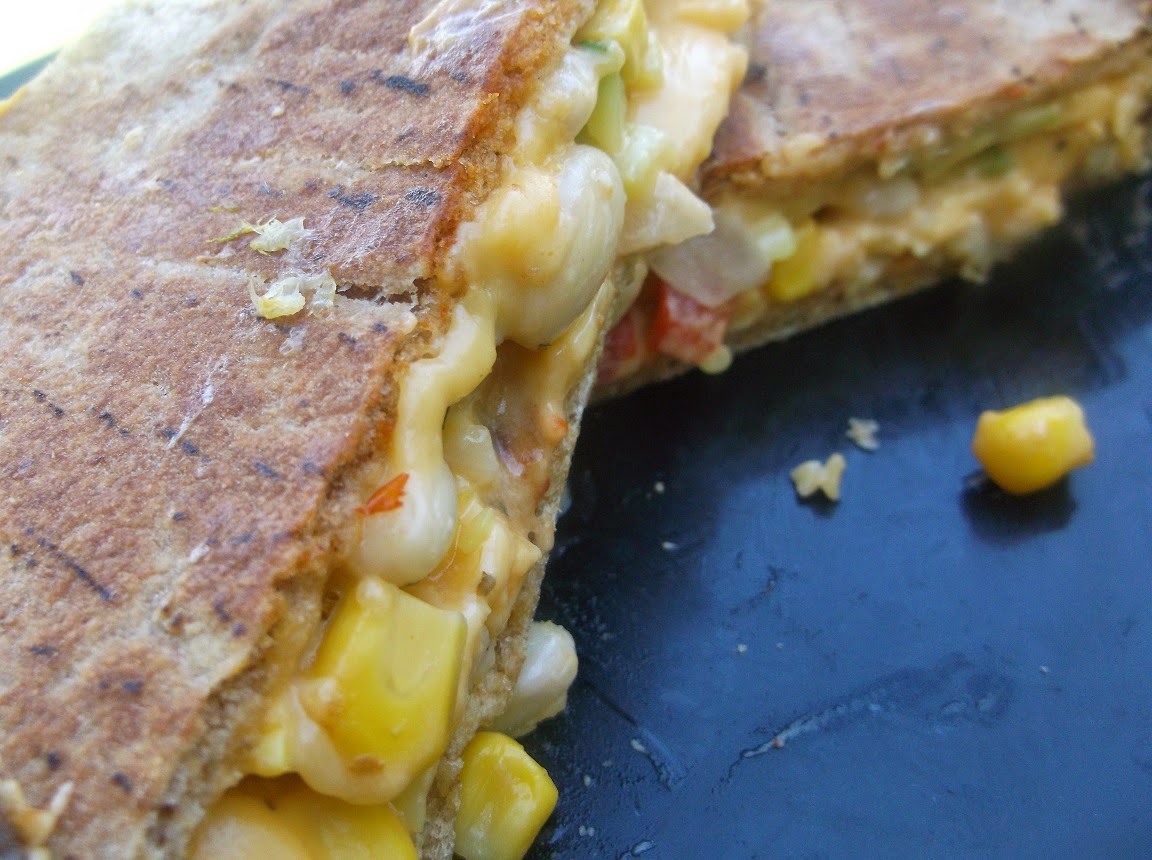


Cheesy Succotash Grill

Want a great and filling grilled cheese sandwich that is truly filling? Here it is, and using Succotash ingredients gives you the satisfaction of protein without the fat. As you know, Succotash has been around for centuries here in New England and many moons before us Europeans coming over. This is, yet again, one of the true, great food gifts bestowed upon us from the Native Americans.

2 small pita breads

Pumpkin Mayonnaise, recipe below
Nonstick cooking spray
1 cup shredded Pepperjack cheese
1 cup whole kernel corn
1/2 small diced tomato
1/4 cup diced onion
1/2 cup cooked great northern beans*
1/2 cup diced, cooked chicken


With a sharp knife, insert it into the pita bread and cut around it to form two thin halves. Repeat with other pita. In a small bowl, mix 1/4 cup mayonnaise with 2 tablespoons pumpkin, 1/2 teaspoon chili powder, 1/4 teaspoon cumin, 1/4 teaspoon salt and black pepper; mix well; set aside. Spray the outer outer half of two pitas and place in a large skillet over medium-low heat. Spread some Pumpkin Mayonnaise and top with equal amounts of half the cheese, corn, tomato, onion, beans and chicken. Sprinkle remainder of the cheese over both and top with the other halves of the pita, with more Pumpkin Mayonnaise spread over each. Cook, flattening down with a spatula, until it is starting to crisp. Carefully flip over to finish crisping on the other side. Remove and enjoy.


*Lima, fava, kidney or cooked pinto beans would be equally delicious


Tempting Jagasse

Not many people know, or even heard, of Jagasse. In the early 1800s, fishermen along the Massachusetts coast were also farmers in their 'non-fishing' time. Of course their families had their fill of fish in meals and this dish gave them a subtle hint of the ocean while enjoying the bounty of the garden as well. They used whole fish in their Jagasse, but just the hint of the ocean is all that is needed in this delicious, original Yankee recipe derived from Succotash.

2 strips bacon, diced
1 cup fish broth or clam juice
1/2 small summer squash, diced*
1/2 small zucchini, diced
1 cup whole kernel corn
1/2 cup red bell pepper, minced
1/4 cup minced onion
1 cup cooked navy beans
2 cups cooked rice
1(15-ounce) can tomato sauce
1 teaspoon garlic powder
1 teaspoon onion powder
1/2 teaspoon red pepper flakes
Salt and black pepper to taste


In a large pot, add the bacon and cook until crispy over medium heat. With the bacon and fat still in pot, add the fish broth. Boil for 3 minutes before adding the squash, zucchini, corn, red bell pepper and onion. Stirring occasionally, cook until the vegetables are just barely tender. Add beans, rice, tomato sauce, garlic and onion powders, red pepper and salt and pepper to taste. Stir to combine and continue cooking until everything is heated through.


Enough for 4 side dishes


Monday, January 27, 2014

Behind A Crows Ear


I recently added a recipe for my version of a southern classic, which is grits. This was one of those ingredients that Southerner's are very protective of and swear by their own way of enjoying this corn product. And because of all the emails I received, it looks as though our protectiveness of New England chowder is just as fierce as grits are down South. Although I think my version is VERY tasty, I will not get into the emails that weren't quite so 'delicious'. Rather, I will forward to those of you who asked me the differences between grits and cornmeal, their beginnings and the many spinoffs of both fresh and dried corn, along with some history to boot.


There are many stories and myths regarding how corn came to New England, with one of them being retold more than others of a crow carrying a kernel of corn from Mexico in or behind its' ear. Although great reading, of course it is a fallacy. But having said that, every Food Historian of any note(with a true understanding that not everything can be known)will tell you it is unsure exactly how this happened. It is known, however, that corn made its way north with a little help. Understand that this grass is not something that grows on its own in nature. Humans need to plant it. So it needs not be said that our Native Americans, during the course of their travels north, brought this maize from the highlands of Mexico to the equally high, mountainous regions of the Eastern United States. Along the way, however, the white gourdseed corn dominated. This softer-kerneled corn took longer to grow and matured far later than the northern Flint, which was perfect for the warmer climates where the extra time was available for its full growth. This white corn is the beginning of the Southerners grits.


Along with corn, our native Americans revered squash(or pumpkin) and beans, making this trio known as the "Three Sisters". Western Europe had conception of the corn that had been growing on this soil. They actually referred to almost all grains as corn until Christopher Columbus introduced it. he proclaimed in his 1492 journal as "well tasted, baked and dried and made into flour."

By the time Europeans settled this land, the American Indians were growing a good variety of corn, including Dent, Flint, Sweet and Popcorn, but not as we know them today.


Dent corn, in particular Sweet Dent Corn, was said to have been developed by James Reid in the 19th century. While he may have cross pollinated Flint with Floury corns to produce this field corn with the distinctive 'dent' in each kernel, it is the Native Americans who first grew Dent corn. It was, and still is, the most popular form of corn to be dried and ground for use in all things requiring cornmeal because of its' very thick outer skin that truly doesn't soften when boiled. It is said that this was the type of corn that Josselyn was speaking of in his account of 1674 about the Native Americans using sacks to store, and travel with, their "powdered cornmeal":

"which they make use of when stormie weather or the like will not suffer them to look out for their food".


Roger Williams, of where else but Rhode Island continues in 1643:

"I have travelled with neere 200. of them at once, neere 100. miles through the woods, every man carrying a little Basket of this[cornmeal] at his back, and sometimes in a hollow Leather Girdle about his middle, sufficient for a man three or foure daies".


Flint corn(which is often referred to as Indian corn, is of the same species of Indian corn but has a lower water content and is very resistant to the freezing temperatures found in Northern New England. In fact, it is said that during the Year Without a Summer(1816) it was the ONLY crop not to have been completely decimated by the frigid conditions in Vermont. this episode is well worth reading about by the way because it was felt world-wide, but most devastated was northern New England where snow flee in June and freezing temperatures ruined crops throughout the East coast of the U.S..

Early Indian corn was one color per stalk, with all colors growing throughout New England. The Native Americans kept the colors separated. Today, because of cross pollination, we have multi-colored ears of Indian corn. And to set the record straight, ALL corn today is actually Indian corn because our Native Americans grew all types of corn, including Dent and Flour.

Want to know what the early corn looked like?


While today’s corn has roughly 30 rows of kernels, early corn had between 8-12 rows, with the circumference of each ear being half of what we propagate now.

Did you know that the decorative multi-colored Indian corn is indeed edible? Yup! As with any corn, it should be picked prematurely. That's right. We pick our super sweet corn prematurely even today. That is why it is sweet! Corn was meant to be aged past the sweet phase and into the starch phase. As corn ripens, the sugar content turns to starch and, thusly, becomes not only chewy but less sweet as well. Even though Indian corn may not be very sweet when picked before the conversion to starch, it does retain some sugar and completely edible.


No part of the corn was wasted back then, nor is it today. The corn could be eaten green, or dried for storage and grinding. Surplus(including the stalks), cattle and poultry, with any remainder after that to be distilled into alcohol. As with the other parts of the corn, dried cobs were made into pipes, jug stoppers and tool handles while the husks were great, dried, to start fires with and to fill mattresses. The Native Americans even made a type of moccasin from the dried leaves. The husks were also used by many of our fore-mothers, when they were children, to make corn-husk dolls up until well into the 20th century. Bartering, as cash, for items needed in the home was commonplace as well, even for furs and meat well into the 19th century.

Today’s super sweet corn has been genetically modified so that the conversion of sugar to starch inside the endosperm of the corn kernel has been slowed, thereby making it last longer from the field to the table. It used to be that once you picked corn, the sweetness was declining to the taste about 20 minutes after picking. Now, days can go buy without a noticeable difference in taste.

Papoon, the Iroquois name for what we now know as sweet corn, was first introduced by the Indians to the European settlers here in New England around 1780. Country Gentleman(a white kerneled sweet corn) and Stowell's Evergreen are two varieties still around that our forefathers enjoyed. It is also known that during this same period, it is widely believed that Lt. Bagnal, a member of Sullivan's Expedition again the Iroquois, brought sweet corn seeds from the Susquahana Valley in New York to Massachusetts while Thomas Jefferson also mentions growing "shriveled corn" in his 1810 Garden Book.


Now that we have touched on the beginnings of all corn products, let's decipher individual products that is the basis for many recipes we taste today.(Finally, huh?)


Picture of Thomas Jefferson's garden, courtesy of vnews.com

Let's start with grits. Literally meaning coarse meal, from the Old English grytt, it originally meant any porridge made of wheat and other grains. More commonly called groats in England because, as I mentioned earlier in the article, all porridge consumed was made of grains such as wheat and oats, but not the corn we know of today.


Grits come in both yellow(the whole kernel) and the predominant white(hulled kernels of corn). The corn used for grits? Southern Flint or white gourdseed corn, as mentioned above.

Modern grits are now generally made of hominy, which is result of corn having the hull and germ removed through a process called nixtamalization. Nixtamalization is simply the soaking and cooking of corn in an alkaline solution of lye/lime and ash. I know how we all hate the fact that everything we put in our body is so chemically altered in some way now, and nixtamalization being another, but pallagra(a niacin deficiency) is negated by this process.


Killing the corn's germ also prevents the corn from sprouting while in storage, as our ancestors found at least as far back as 2000 B.C, when the Mexican population began slagging their corn in lye and ash.


If you have ever read Laura Ingalls Wilder's book, Little House in the Big Woods, you will find a passage on how hominy was made more than a century ago(also telling the reader how to make the extremely popular New England favorite, Maple Candy, which was boiling maple syrup "thrown" on snow and always enjoyed with a sour pickle by the adults).


"The first day, Ma cleaned and brushed the ashes out of the cookstove. Then she burned some clean bright hardwood, and saved its ashes. She put the hardwood ashes in a little cloth bag. . . .

Early the next day Ma put the shelled corn and the bag of ashes into the big iron kettle. She filled the kettle with water, and kept it boiling a long time. At last the kernels of corn began to swell, and they swelled and swelled until their skins split open and began to peel off. . . .

With her hands she rubbed and scrubbed the corn until the hulls came off and floated on top of the water. . . .She never splashed a drop of water on her pretty dress.

When all the corn was done, Ma put the white kernels in a big jar in the pantry. Then, at last, they had hulled corn and milk for supper.

Hominy hominy hominy!"


There have been many myths and handed-down stories of grits in the South, with my favorite being that grits make ones bowel move, but cornmeal doesn't. That being said, grits are found in supermarkets everywhere, even up here in New England where we find three types of grinds, fine, medium and coarse. True Southerner’s will tell you that the only true grits are the old-fashioned stone ground while others say steel-ground are the best. But I do believe there are times when you will find even them purchasing quick grits. These are very finely ground hominy that is pre-steamed for a 5-minute cook. I find this a great alternative, although regular grits can be made in about 10 minutes.

Now about the taste! I have absolutely no problem telling you that grits is bland dish, just like I will exhort that cornmeal mush is just as bland tasting, that's why we add so many different types of flavorings. Even Bill Neal and David Perry, authors of one of the best cookbooks about this Southern staple entitled Good Old Grits Cookbook, say that grits are bland. Suffice it to say, almost everyone adds some type of flavoring, butter, salt and pepper chief among them. That is also why, when you see selections at restaurants or talk to families who grew up on grits, they will tell you that "grits-and-gravy", "grits-and-ham" and "grits-and-eggs" are the dishes most often associated with this bland "cornmeal". I actually adore grits with red-eye gravy(a reduction of pan juices from cooking ham, adding coffee and pepper). But I also enjoy grits made with a New England element in the way of Cheddar cheese, which is almost consecration in the eyes of the ardent grits lover wayyyy down South, although more and more grits-lovers are coming around.


Not to be outdone, us Northerners enjoy, and always have, our yellow cornmeal. This is simply ground, dried corn which also comes in various grinds as does grits. The finest is referred to, most often, as cornflour. Cornflour, by the way, denotes cornstarch in England, as cornmeal is known as polenta. (Don't make me explain)

We also have our "hell-bent" cornmeal lovers here in New England. Some stick with the steel ground yellow cornmeal, with the husk and germ of the kernel removed. The purists here in the North say that stone-ground cornmeal is the best. This cornmeal still retains some of the hull and germ, thereby giving it slightly more flavor. It is interesting to note that while grits have only one use, while yellow cornmeal has many. As my children would say, "just sayin' ".


Not to be outdone, the Mid-West also have cornmeal that is seldom seen, let alone used, here in New England. Blue and Red Cornmeal. Yup, there is a red corn. Although we generally see chefs with an affinity to Southwestern cuisine(such as Bobby Flay) prepare many dishes using blue cornmeal, red corn is just as flavorful. Blue corn, which contains about 20 % more protein than either yellow or white corn, is commonly used in tortilla chips while red is all but forgotten. Both have a much more intense corn flavor than yellow or white cornmeal, but with that extra flavor, it loses the sweetness of yellow corn. Both of these can be eaten in a raw or boiled state, but I think the sight of either blue or red corn on the cob has people thinking otherwise.


For many centuries, us Yankees have enjoyed(well we enjoyed it 'way back when' anyway) a dish called Cornmeal Mush. This was simply dried, ground yellow corn that has been boiled in water. In Italy, this is called Polenta. Why? My elemental theory is that if you see Cornmeal Mush on a menu, you would not be willing to pay more than a buck for it, if anything. While a menu that stated Polenta would easily herald oohs and ahhs while commanding a price of $10-$12 easily. BUT THEY ARE BOTH THE SAME THING!

When our fore-"mothers" made this dish, it was usually a ratio of four parts water to one part cornmeal, boiled for about 20 minutes with butter or drippings added. During the 19th century, jam, maple syrup, molasses, brown sugar, diced fruit and other seasonings were added to make a more palatable breakfast.


Now what I have not touched on in this article is the most famous dishes made with yellow cornmeal, and those are Jonnycakes and Jonnybreads. Find this "essay" under Johnny, Jonny or Journey?  very soon both here on my blog or on my website, at theyankeechef.com. Hope I didn't bore you with too much.

Wednesday, September 18, 2013

Taking a Breather


   I have been so busy with my second book, judging, appearances and book signings, I have been neglecting one of my only solace-rendering past-times.....reading. So I grabbed some very old manuscripts, recipes, stories and notes that my father had written before he died and I started reading them. Then I began to think that I should add some old time dishes that our grandparents, great grandparents and ancestors used to subside on and put them online so that they will never be forgotten.
   Some of us calm our nerves and relax by watching television while others take a walk or simply sit and think. I(like my father) love to "remember when...". Even though I don't personally remember these dishes, I have made them time and time again(I truly was meant to have been born many generations ago)
    I do love to think of how my parentage were huddled in their crude cabins in the middle of Bailey Hill with only the fire from the hearth casting its illumination. I love pondering how meals must have been so comforting and satisfyingly odoriferous. Granted we would snub our noses at homemade, real butter now and using leaf or hogs lard is a serious 'no-no' now, but the flavors and aromas of real food surely calmed the rowdy children and soothed the savage husband.
   Let me give you a few old-time dishes you may or may not have heard of. Food that was the energy giver for those hard working folks. People who didn't need to exercise to stay fit, but whose exercise was their daily chores and necessities of living.

Ambrosia, ca 17th century-mid-19th century. When we think of the word ambrosia today, some type of fruit salad mixed with a dairy product and topped with coconut comes to mind. Back a few generations, ambrosia(literally meaning food of the Gods) was simply corn. Generally it was the dried and milled corn that was deemed such.
   Hasty Pudding was made with dried corn(henceforth referred to as cornmeal). And although many of us have heard of Hasty or Indian Pudding, not so many knew that it was an absolute sin for it to be the least bit lumpy. My father used to say that it was originally made with milk and eggs and a "trifle of Muscovado sugar or Portorique molasses". Brown sugar sauce was generally made to top it off, which was just melted brown sugar.
   Back in the day, Indian pudding wasn't the insipid recipe many chefs use today, but nicely stirred, well-boiled without any two particles sticking together. People, also, don't know to to classically enjoy this dish as well. A spoon should be dipped into milk before it lifts the pudding to the mouth. This keeps it from sticking not only to the spoon, but to the inside of your mouth. It was meant to be enjoyed one spoonful at a time, each bite completely separated from the next.
   And do you think the Italians were the first to enjoy polenta? No, no, no, no! Eating hot Indian or Hasty Pudding was just as often seen in our homesteads of old as was cutting it when cold and grilling it in lard the next day. It is often written that when fried in fresh butter of cows who only ate clover, this meal was fit for a king.

Milk Porridge, ca 17th century-late 19th century. First water was boiled. Cornmeal was then added through ones fingers(acting as a type of coarse strainer) and the other hand was gripping a wooden paddle, stirring as the cornmeal was added to the water. When the corn was added, and the lot stirred for a time, fresh milk directly from the cow was very slowly added. It is said that you should not add the milk until you could see your nose reflecting off the surface of the cornmeal/water mixture.

Corn Biscuit, ca 18th century-late 19th century. This was an Indian luxury, and was made with one pound of butter, one pound of sugar, ten eggs and a pint of new milk, with just enough cornmeal to mold it into thin cakes. Sound familiar? It is now known as Pound Cake!

Whitpot, ?-mid-18th century. A very thin Indian Pudding, baked in a very slow oven(low temp) so that the milk, eggs and molasses formed a jelly throughout the entire pudding.

Herring Sticks, ?-late 19th century. From mid-May to mid-June, the herring run was on in all of New England in days gone by. Many old texts referred to Cape Cod herring as an alewife. Often called a "poor mans fish", it was freely gifted each year by the town to each child born within the township limits. Many townships actually enacted legislation ordering just such a gift!
  The herring was so plentiful that townships were not able to eat or locally sell them, so they were shipped to larger cities. One older lady, in her journal from New Hampshire, relates "I do relish a nice fresh herring with my breakfast".
   Salting and smoking was the norm to help keep a family fed through the lean months. Before salting or smoking, however, they were strung on sticks. The sticks were for the most part whittled from cedar, stripped from the old cedar, split rail fences everyone had around their property. The cedar sticks were passed through the gills of the fish with a dozen or so strung on each. On many New England roads, the lettered signs on the fences used to read, "Herring  10 cents a stick".

Lobster Stew. Now of course many, if not all, of us have heard of Lobster Stew, but would you like to know how to truly make it the old-fashioned way? The correct way? A little trivia first. Lobster Stew was almost always accompanied with a couple of sour pickles.
   Begin with the tomalley. Saute it in an equal amount of butter in a thick cast iron skillet for 5  minutes. Add the cooked and picked lobster meat and every bit of juice that came from the cooked lobster as you were shelling it. The ratio between lobster meat and juice should be about 50-50. You don't ever, EVER, add salt or pepper to lobster stew! Old cooks and housewives used to relate that lobsters got plenty of salt and seasoning from the ocean it lived in. I tend to agree!!
   Leave this stew on a hot fire for 5 minutes, then push it back to a cooler part of the stove to come down from boiling to a bare simmer for about 15 minutes. While still barely simmering, slowly(and they did mean SLOWLY) add your milk. Housewives say to "trickle" the milk into the stew, while constantly stirring. Add  rich cream after the milk has been added. When the stew blossoms out suddenly into a rich salmon pink under your spoon, you can know that the stew has been made properly and is now to remove from all heat sources and let cool for a hours . My father used to say that cooling the stew was just as important as making it. The flavor increases drastically. True lobster stew wasn't meant to be consumed when it is made, but rather cooled for many hours then reheated to enjoy.  As if.....

Muslin Toast, 18th century-mid-19th century. This was a favorite supper dish of many Yankee families. Now remember that dinner(or the noontime meal) was the heartiest of all repasts during the day, while supper was just enough food to hold you over until the table was laden for breakfast. Muslin Toast was a type of rye shortcake, the size of the skillet, that was grilled in sweet homemade butter on each side until very crispy. As each side was crispy, it was cut off and set aside. This was repeated until you had about 7-8 thinly crisped slivers of shortcake, with the last slice being grilled. All these crispy slices were then placed in a bowl of hot, thickened and salted milk.


My how times and appetites have changed. I loved looking back and I think I will continue this post within the next few days.

Sunday, September 1, 2013

Just in time for Labor Day!

Ordinarily I would be posting recipes on my new website, theyankeechef.com, but my webmaster told me to stay the hell off it. Apparently I was doing more harm than good. All I can say in my defense is that my 15 year old wasn't there to help me with it. (Pretty sad huh? A grown man needing his young son for help[ with the computer?!)
I gladly relinquish that tedious job, but at least I can still post here once in a while. And besides, I don't need to edit so heavily here on my blog.

My father used to regale me with a story about his grandfather cooking corn. He told me that Frank(his grandfather) would wait by the woodstove for the pot of water to boil, when the corn was ready for picking. When the water started vigorously boiling, he would grab a couple of rags and grab the pot. Wasting no time, he would bolt out the back door with that dangerous pot of boiling water and head for the corn row. Setting it on the ground, Grampy Frank would rip off the corn silk and leaves and bend that stalk over so that the ear of corn would be submersed in that pot of water. It was only then that he would cut the ear from the stalk and continue on to as many as he could fit in that pot.
When full, he would then run back to the house and place that full pot of fresh corn on the cob back onto the stove to continue cooking till done.
Now don't laugh, there is some science behind this. Corn on the cob almost immediately begins to lose its natural sugars the moment it is picked, converting it to starch. So who do you think had the sweetest corn for supper those nights?
These recipes may sound a little out of the ordinary, but I assure you that one of them will be to your liking. So git the napkins out and commence to dripping butter down your chin.


Corn on the Cob with Garlic-Herb Butter
The perfect combination of that garlic flavor will compliment any protein dish you will be enjoying with your corn on the cob.


6 ears fresh corn on the cob, cooked
1 stick of butter or margarine
1 teaspoon minced garlic in oil
1/2 teaspoon cayenne pepper
Parsley

Allow butter to come to room temperature. Mash garlic with a a mortar and pestle or simply use a sturdy fork so the garlic is mashed. It doesn't have to be lump-free however. . Beat butter with a hand-held or table top mixer until light and airy. Add the garlic, cayenne pepper and whatever amount of dried or freshly chopped parsley you desire. Continue beating until well blended. Cover and refrigerate until needed to slather on your hot corn on the cob.


Milk-Poached Corn on the Cob
By far, my favorite way to enjoy corn on the cob. I can't quite put my finger on it, but the milk does something to this corn that simple water cannot!


6 ears fresh corn on the cob, broken in half if desired
1 quart milk
2 cups water*
3 tablespoons butter or margarine

Place the milk, water, butter and corn in a large pot with tight fitting lid. Place the pot over medium heat until it starts to boil. Reduce heat to medium low and gently simmer corn for 20 minutes. Remove lid every few minutes to rotate corn if it isn't completely submerged in the poaching liquid. Remove from heat and serve up straight from the liquid.

* or use 1 1/2 quarts low fat milk


Sweet and Salty Corn on the Cob
Hey!!!Don't cringe yet. Give it some thought. The corn is sweet and with the tiny little bit of honey mixed in with the butter, it can only heighten the taste of the corn. And about the bacon. It was just an item that popped into my head and I sure am glad I gave it a whirl. This is delicious, even after the third ear.

6 ears of fresh corn on the cob, cooked
1 stick butter or margarine
3 tablespoons honey
1 strip bacon, cooked and crumbled*

Let butter come to room temperature. With a hand-held or tabletop mixer, beat the butter on high for about 2 minutes, or until it is light and airy. Slowly beat in the honey until well incorporated. Add the bacon and continue beating until mixed well.Transfer to a bowl and cover to refrigerate until needed.


*Turkey bacon works very well here too.


Friday, November 16, 2012

The Yankee Chef and Durgin Park

Missed But Not Forgotten

This is a dish I had forgotten about for so long, I almost forgot how to make it. Although this is only the second time I have used lobster in it, I found myself needing to share this delightfully festive dish. My grandfather made this each and every Holiday for each and every Thanksgiving menu at his restaurant. Although The Yankee Chef believes the origins lay somewhere around Kentucky, us Yankee's have been using corn and lobster since we first set foot on these shores, so if you don't mind, I claim this superb accompaniment to your table as Yankee!

The Yankee Chef and Durgin Park

A friend of mine, Melicia Philips is the Executive Chef at Durgin Park, next to Faneuil Hall, in Boston. We have been staying in touch as of late and I asked her for a recipe she wouldn't mind sharing with my readers. It worked out kind of funny because I had just gotten done with my own version of a Corn Pudding when she forwarded me hers. Far be it from me to outdo Chef Melicia or Durgin Park, nor would I even attempt to, so I included both our recipes in this column. I am blessed to be able to call her friend, and even more blessed that she has agreed to write a review for my cookbook. So without me further entertaining you with gloat, here are both recipes that have been part of our Yankee heritage for as long as us Yankees have been here in New England.


New England Shore Corn Pudding
The combination of lobster and corn just pairs two naturally sweet items so well together, I think you will find yourself making this within a week of Thanksgiving. Just remember, serve this as a side dish along with either soup, bread or the main course. You can even heighten the flavor by roasting cleaned ears of corn in the oven first for 20 minutes on 400-degrees F. Remove, let cool enough to handle and then remove the corn kernels, making this New England Shore Roasted Corn Pudding.

4 c. cooked lobster meat, chopped
4 ears of corn*, silk and husk removed.
2 c. half-and-half
4 strips bacon, chopped
1/2 red bell pepper, minced
4 scallions or green onions, sliced thinly
6 eggs
1/4 c. flour
1 t. salt
1 t. sugar
1 c. shredded Monterey jack cheese

Preheat oven to 350-degrees F. Coat eight 8 oz. ramekins or one shallow 2-quart casserole dish with nonstick cooking spray. Remove corn kernels from each ear using a sharp knife. Holding ear of corn with the stem up(it is easier if you cut off the tip of the ear so that it stands up more securely)run the knife from top to bottom over a plate. In the bowl of a food processor or blender, puree half the corn with 1/2 c. half and half.
In a large skillet, cook bacon over medium-high heat until almost crisp: drain fat. Add remaining corn kernels, sweet pepper and scallion; saute for 5 minutes. In bowl, whisk remaining half-and-half, eggs, flour, salt and sugar. Stir in lobster, pureed corn, sauteed vegetables and cheese. Divide among ramekins or pour into large casserole. Set individual casseroles or large casserole in baking pan and place in oven; pour hot water into baking pan to 1-inch. Bake for 35-40 minutes, or 5-10 minutes longer for large casserole dish, or until knife inserted in center comes out clean. Let stand for 15 minutes before serving.

*Take the easy route if you wish. Use one(15 oz.) can of whole kernel corn-drained or the equivalent in frozen corn.


Chef Melicia's New England Corn Custard

2 c fresh corn kernels
2 c cream(heavy is best)
3 eggs
2 egg yolks
Salt and pepper to taste
Nutmeg, to taste
Cayenne, to taste
Curry powder, to taste

Butter 15 small ramekins.Mix all ingredients together well and fill each ramekin equally with custard. Cover with foil and bake in water bath at 350 degrees F until set. Remove from water bath, let rest 5 minutes. Run a butter knife around the inside edge and invert onto a plate.