Thursday, June 2, 2022

Simple Yankee Way of Life


American and international literature is inundated with images of the old New England home and hearth. From Longfellow's depiction of Priscilla Mullins at her spinning wheel in The Courtship of Miles Standish to the fantastic musings of Harriet Beecher Stowe in Oldtown Folks. Frugality, hard word and dry morality are given "air-time" by Francis Underwood in Quabbin, but with equally warm, satisfying and level-headed principles paralleling. Some may say a Yankee home is the ideal home, a small cottage nestled in amongst the tall pines while the rest of the world whizzes by physically and technologically. In some ways, it is true but I do think that is why home and hearth(not to mention family ties) is so important to us and why New England has always been, and will continue to be, the epitome of comfort food.


Although I must preface my introduction to the New England way of living as relaxed, we are still informed. The domestic images that have enchanted New England writers and artists since time immemorial have been romanticized, but not exaggerated. Even many academic historians display their interpretation of the New England home and hearth with the same colorful representation as Whittier and Jewett. And you know the old adage, there is a grain of truth even in folklore.


Find below a brief account of who we are, for that has directly evolved from where we came from and how we got here. Let me tell you a little story.


During the early part of new England's colonization and well into the 19th century, families cooked in the fireplace. Large kettles or pots were seen in every home. Most of the time, a certain pot was solely used for soap making while boiling and stewing food was done in another. Having a nest of iron pots of different sizes, a gridiron, Dutch oven, skillets of various dimensions along with a spider and bakeware were essential to early cooking. For those who could afford it, brass kettles were often seen in door yards of old filled with pale, white, bubbling homemade soap or fresh tree sap being reduced for the family's year-long sugar needs.


Francis Underwood, author of Quabbin, extolled the "girth" of breakfasts in the late 19th centuries

 ..... "a substantial breakfast that was begun by a preliminary nip of hard cider. This might be followed by ham and eggs, or a salt fish prepared with cream, or of bean porridge(for which a ham bone furnished the stock), or of cold corned beef, with hot potatoes, and usually hot bread(called 'biscuits') resembling muffins; and with sauces, pickles, and other provocatives in plenty."


Although Mr. Underwood was writing fictionally, it truly resembled the breakfasts of a few generations ago.....well, maybe a light breakfast. This author has read accounts of much heartier morning fare. But why so much breakfast? Because Yankee's had much to do.


Harriet Beecher Stowe also mentions food in her Oldtown Folks, "I can inform all whom it may concern that rye and Indian bread, smoking hot, on a cold winter morning, together with savory sausges, pork, and beans, formed a breakfast fit for a king, if the king had earned it by getting up in a cold room, washing in ice-water, tumbling through snow drifts, and foddering cattle." There are also many accounts of family's waking up in the middle of the night or in the morning covered with a fine dusting of snow because of the unchinked openings between the logs of the home.


Harriet's representation of the New England breakfast was more of the norm than Mr. Underwood's, although many of our ancestors subsisted on any leftovers from the night before or simply milk, bread or porridge.


Although we do love our time together nestled around the dinner table and talking about the days events, back a couple of hundred years ago meals were, more often than not, just simply time enough to quench your hunger as opposed to relaxing and gossiping. This way, the days' work could either be started or finished without loosing much time.


The difference between lunch, dinner and supper.

The travelling aristocrats that came here from abroad often demeaned much of what us Yankee's either ate, were employed at or our everyday life habits. Cases in point. In many self written books from the Puritan to the Colonial era by these same affluent and wealthy "tourists", there are narratives about the pewter and ceramic serving dishes of the 'typical' New England family. This was not, and I repeat NOT, what most families ate from . Certainly a single large pewter platter or goblet was seen in many homes, but this was usually an artifact that was handed down from one generation to another or that particular family only was able to afford one. Homemade wooden trenchers were widespread throughout our homes, much to the chagrin of these wealthier travelers from abroad.


Also, the habit of 'taking dinner' in the middle of the day while 'refreshing our bodies' with a small viand(the supper) in the early evening was something often ridiculed by those who were ignorantly blind to our dinnerware. During what we call lunch now, our ancestors piled on the food in the middle of the table for everyone to dig into. And most of the time during this meal(especially in the backwoods of New England and the poorer communities) this consisted of a piece of pork surrounded by boiled beans. Nothing fancy, nothing extravagant, just pure fuel for our bodies. Sure we had cheeses, pies, cakes and various sweet treats, but these were lavished on the household infrequently up until the 19th century. It was from the early 1800s onward that we see variety on the kitchen table because of the prevalence of spices, fruits, sugar and all things that couldn't be grown in New England soil but were either bartered for or shipped into the local "store".


  Lyndon Freeman of Sturbridge, Massachusetts writes(early 1800s):


"At the setting in of winter every farmer was presumed to have at least a pork and beef of sufficient quantity. The larder was well supplied with butter, cheese, applesauce, pickles, sausages, souse, etc. Their dinner commonly consisted of boiled pork or beef or both, potatoes, cabbage, beets, carrots, etc.....A mug of cider was upon the table never forgotten of as all drank as freely as we do of water today. The meat and sauce left of the dinner were hash-up for breakfast the next morning. The supper was usually brown bread and milk for all."


Food was also a way of obtaining much needed supplies for a large family. There truly shouldn't be much of a distinction between bartering and paying from the early New England era. Since few people had actual cash, gong to the "store" to obtain and pay for supplies was usually done with whatever extra the family had. Wool, tools, pots and pans, ironwork and spices were bartered at every store and even this type of system was prevalent among neighbors. I f one family had an abundance of butter or cheese and their neighbors had a good stash of vegetables or rum, you bet neighbors subsisted on each others kindness. Many men would also take in any food items they were blessed with an abundance of to the nearest tavern as well, in exchange for a few nips of rum or port but store barter for barrels of coffee, tea, tools, molasses and flour. Over time, housewives were able to barter for cinnamon, sage, nutmeg, pepper, cloves, mace and many other essential additions in our well known baking repertoire.


For families to have bread or cakes, some type of meal was needed. Be it wheat, rye or corn, all three needed to me ground. And in the winter when the rivers and streams of New England froze, this was next to impossible for a community to do. In order to keep a supply on hand, you either had to plant plenty of corn to dry  and bring to the grist mill before winter or barter.

Some type of leavening was also needed for baking and this was rather easy to keep on hand, even the poorest of homes. Skimming the top barm from a barrel of cider usually did the trick for light and airy breads well as pinching a knob of dough from one unbaked loaf to keep for the next batch. Then another pinch would be taken from that loaf for the next. On and on this frugality occurred and now you know where us Yankee's get if from. There is even an account in my family of  Ol'  Gus Bailey who dipped his spoon in a pile of "new fallen snow" and mixed it in with biscuit batter in a lumber camp to leaven these white must-haves with baked beans. Did it work? Sure did!


Baking day was but once a week for those who had an oven built into their fireplaces. For those who didn't, this is where neighbors came in handy yet again! Many families had their own Dutch ovens though, because of the scarcity of neighbors in many rural communities. These were shallow iron kettles that stood over coals with three legs and were fitted with a deep lid onto which hot coals would be piled in order to offer all-around heat. Can you imagine puddings, pastries, cakes, gingerbreads, custards and cobblers baked this way?  I certainly would love to take a trip back in time just for one day not only to taste what was cooking on the open hearth but to sample the cheeses that were homemade, with not one tasting like the other.
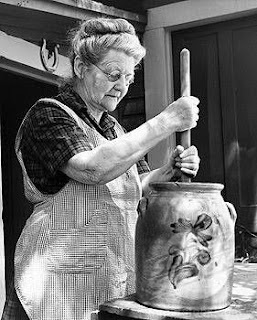


Churning and cheese days were also a chore that, although needed to be done, was not met with open arms. With the females of the home obtaining the milk, this was just the beginning. The pails needed to be scrubbed first, then the milk was to be scalded, skimmed and churned. The butter then had to be worked and that was no easy chore.


Sarah Emery, an ancestor of mine, relates:


"In those summer days, when my recollection first opens, mother and aunt Sarah rose in the early dawn, and taking the well-scoured wooden pails from the bench by the back door, repaired to the cow yard behind the barn. We owned six cows; my grandmother four. Having milked the ten cows, the milk was strained, their fires built, and breakfast prepared...The milk being from the ten cows, my mother made cheese four days. Aunt Sarah having the milk the remainder of the week. In this way, good-sized cheeses were obtained. The curd having been broken into the basket, the dishes were washed, and unless there was washing or other extra work, the house was righted. By the time this was done, the curd was ready for the (cheese) press....After dinner the cheeses were turned and rubbed." The cheese would then be stored in the buttery.


More commonly known, at the time, as a buttery, this room was generally the cellar where the cool air was needed in order to set the pans of milk and ripen the  cheese. Many rural families denoted a lean-to as a buttery as well, using their cellar for vegetables and cider. But the cheeses were always kept down in this "root cellar" for keeping throughout the winter to prevent freezing, while meats were kept in these lean-to's.


There is nothing that irks me more than reading that meat and fish were not that plentiful for our ancestors. Many famous historians have mentioned that it was a rare treat for the man of the house to have any wild life barreled up for his family. That ranks right up there with another historical inaccuracy purveyed by most of the history professors and authors of New England life, which is that us Yankee's very seldom lived in log cabins. Absolutely rubbish this Yankee avers to both.


It is true that our Puritan ancestors relied heavily on salted meat and fish, but as the generations passed, fresh meat and fish was more the staple because of better guns and methods of fishing and trapping. Although historians say that fresh meat was hard for our 18th and 19th century forefathers to find, not only is this inaccurate, but we were still salting our meats for winter preservation. Why? Mostly because we always made sure our family's were secure in every aspect, but especially being fed. It was far better to have more than not enough and with such large families and hard work for everyone in the household, extra food was still not the norm.


When it was butchering time, usually in the late fall when the weather here in New England was cold enough to preserve without much salt, everyone helped with the slaughter. From cleaning the tripe, trying out tallow and lard, getting the head and feet ready for making headcheese or foot pies, cleaning out the intestines for sausage casings and cutting the meat into family-sized portions for preservation in fat or salt. Hams were salted as well, to ready it for the smoke house and fish was cleaned and hung from the rafters to dry out.


I am not ashamed to say that our poorer ancestors(as many of mine were) along with the more remote populations, forest creatures of every type were caught, trapped and shot for consumption. I have so many hand-written notes and recipes from my ancestors for partridges, quails, woodchucks, beaver, squirrel, birds of all types, musquash, rat, porcupine and skunks, to name a few.


The same holds true for our lakes, streams, rivers and ocean. My father(right up until the day he died) always prepared eel the same way, he said, our great great great grandmother did during the Revolutionary War period. I remember well Dad stringing up the eel on the side of the house and ,with a dry cloth and sharp knife, he would draw the skin from the tail end to the head. Gutting it was done while suspended, and leaving the head intact. He would then skewer that bad boy with a long, green stick from the woods behind our house and "barbecue" it over an open fire. To this day, that is the only way I will thoroughly enjoy eel.


Try this on for size! Did you know that lobsters were so plentiful in the early days of New England that many families, including the poorer farming households, looked at lobsters with disdain. The reason? Because before the over-harvesting of these delectables, these crustaceans literally littered our shoreline. They would wash up on shore by the hundreds, along the many miles of New England. After a number of years of the free-for-all taking, families simply stopped snatching them up because they 'had their fill'. I just can't imagine ever getting sick of lobsters, but then again I have never had the pleasure of eating them day in and day out.


It is easy to imagine the basis of our New England standby of codfish cakes and codfish balls every Saturday night and Sunday mornings. Fish of all sorts was that important and available throughout our waterways. The most abundant, believe it or not, was salmon, shad, mackerel and smelts. Unlike meat, fish could not be frozen to preserve. Salting or drying had to be accomplished in order to store for the winter when it was simply too much work to dig through the ice to fish. The most amazing dish I have ever eaten that was prepared according to an old-time "receipt" book was Cod Scootin 'Long the Shore. It was prepared by cutting up cod and placing in a cast iron skillet that is been greased with some bacon. On top of it lay some diced potatoes, beets, onions and some salt pork. Drizzle some oil over the top, salt and pepper liberally and cover. Baked in an oven until done. This classic Yankee dish rivals any Michelin-star meal served anywhere. Fish was often served or cooked with vegetables during our Yankee beginnings because of the salt used to cure fish. Vegetables seemed to take the 'bite' out of this spice.


I have had the pleasure of visiting my ancestors homes, although all that is left are their "root cellars", which were rock lined cellar holes. I have found two of them, one made by the hands of my great great grandfather(Josiah Bailey, 1778-1869) and his father(Nathaniel Bayley, 1740-1796). I just stand at the edge of each hole and marvel at the work it must have taken to not only dig the hole but roll these boulders into it to make these cellars. And to top it all off, within 20 feet of each was their rock lined water well. Now THAT was a marvel of engineering. One of them is at least 30 feet deep and lined with rocks that are still solidly intact unto this day(2013).


In these root cellars, our fore-families kept their apples, cabbage, pumpkins, turnip, beans, peas, beans, potatoes, carrots and squash. They would easily last the entire winter without softening in the least bit. As for the corn, we dug corn holes, or potato holes as some have referred in journals of old, in order to keep corn from shriveling up too fast. Although we dried much of our corn harvest for grinding, corn could be kept better by covering with birch bark and pine boughs, then covered with a layer of dirt to keep the wild-life from scavenging. This method was taught to us from our Native American friends. In fact, my ancestor, Nathaniel Bailey, was stabbed to death in 1796 by a Native American after digging a corn hole. He had agreed to pay a Passamaquoddy Indian in rum if he helped with the harvest and storage of corn in one of these corn holes. One night when the rum was all imbibed by the Passamaquoddy, he came back to Nathaniel's cabin on top of Bailey Hill in Baileyville, Maine and wanted more rum. Not having any left, the Native American began to get angry and stabbed Nathaniel to death.


My book, above and here on Amazon, tells Nathaniel's complete story for  the first time. An Amazing Journey also includes a treasure trove of information about life in New England from the 1600s to the 1800s, from the eyes of the backwoods family and those who eked out an existence. 

With regards to fruit and berries, there is no shortage of literature written about our love of all things naturally sweet. Pumpkins, of course, were the number one staple in our kitchen for generations. A seeded out whole pumpkin roasted in the embers of a fireplace, then removed and warm milk from the family's dairy cow poured into the center was a real treat with everyone.


Apples, of course, would be a very close second. When apple picking time was at hand, not only would they be baked in pies, made into applesauce and squeezed for cider and eaten as is, strings of sliced apples filled every home that dotted our landscape. When dried, they could be used for an entire year in everything from savory dishes to sweet. Apple Pie, and Apple Cider Pie, is truly not only an American dish, but a proud Yankee offering to the world.


It is funny to read journal entries of New England family's when they regale of the joy of sharing certain fruits with neighbors. Now you need to remember that many fruits that we take for granted today were simply too expensive and hard to find centuries ago.


In one entry, Ruth Bascom treats her neighbors to a delicacy. In August "sent a piece of our great Savannah Watermelon, which we received 2 or 3 weeks ago cut today and distributed a part to our neighbors."


Even up to my father's day, born in 1938, he would always add an orange to our Christmas stockings growing up in the 1960s. He followed that tradition to the day he died in 2001. I asked him why? Since oranges could be had anytime I wanted to take a trip to the supermarket, yet he made it a point to add one to my stocking every year. His answer was pure Yankee. "When I was a kid" he glumly explained "We didn't have the money to buy much fresh fruit. So when we did get  them, it was a treat. And oranges were too expensive, so my father used to buy them once a year and put them in our stocking".


Cooking and recipes was something that was passed down from one generation to another. I am aftraid that this custom is becoming more scarce as the years zoom by. In this generation, eating out seems to be more of the norm than preparing a meal and eating in. 


Many people thought cookbooks were a waste of money(again, a Yankee dread) because everything you needed to know was taught to you. One needn't measure by the teaspoon or cup. Simply add a pat of butter the size of an egg or scoop out flour with your teacup. You either cooked something over a fire or in a low, moderate or hot oven. Only the upper class, who wanted to indulge with food that was being enjoyed by their equally wealthy English counterparts, began the idea of purchasing cookbooks usually written by someone across the pond in the early days. It wasn't until Amelia Simmons, in 1796, that an American author had made such a great impact on the cookbook craze. What made her cookbook so successful was that she incorporated many ingredients and recipes with the New England housewife in mind. Johnny Cake and Indian Slapjacks are among the recipes that drew even the poorer families to purchase


Wednesday, May 25, 2022

Puttin' Our New England Dialect To Rest

There has been so much debate on the Yankee accent, both about the origin, geographic cut-offs and the 'why's', that I feel the need to finally give it a rest and give you the truth. 

The reason I find myself addressing New England so much lately is because of a certain television show, new this year, that has me thinking if us Yankee's are truly that despised throughout the country, as well as the South. I sure hope not because we certainly don't harbor resentment for any reason toward anyone, honestly! So let's begin by taking some truly ludicrous, too drawn out, too complicated and overly studied opinions, and studies, and give you the correct answer as to why we talk the way we do and everything in between. 


Let's begin by, who I believe to be, a great American(and Yankee)  lexicographer, Noah Webster and his American Dictionary. Many historians have mentioned that Noah's Dictionary was not American at all, but a New England dictionary. I think many scholars preconceived this before they even started reading it, just because of the preface. Noah stated "New Englanders spoke and spelled the purest and best form of English of any people in the world". Bravo Noah! There is also a book that was printed in Boston in 1892, by Francis Underwood, called The Story of a Small Town. In this book, he offers observations regarding our dialect and accent in very unflattering terms, which I assume was the general perception of us Yankees at the time, if you have read my two previous posts::

"The Yankee Twang-

   The nasal tone in New England, it is said, was caused by the severe climate and the         prevalent catarrh; but those were not the sole causes. Catarrh debases speech, both in quality of tone and in distinctiveness of articulation; but the disease is more prevalent now than formerly, while the general speech is probably less nasal. Australians are said to have nasal voices, and they are not afflicted with catarrh. The New England drawl and the nasal tone were probably derived originally from the meeting-house and the prayer meetings; both defects became fixed by habit, and, of course, have been greatly heightened by climatic conditions.

   The virtue constantly insisted upon in the old times by parents and religious teachers was humility, self-abnegation. In repeating passages of Scripture, or of the Catechism the one was subdued. The religious spirit was manifested in awe and reverence, seldom in cheerfulness, and never in exaltation-except in such exaltation as was accompanied with moistened eyes and "tears in the voice". It was "a dying world" in which our fathers lived; the expression of their ideas and feelings would not require the expansive lungs, nor heave the deep chest, of a vigorous and well-developed man. The noise, no less than the manner, of a burly fox-hunter and athlete, would be abhorrent to one whose soul was melted in penitence, and who in his daily devotions intoned in dragging minor intervals the prayers that he dare not address to the Dread Majesty of Heaven with steady eyes and many voice......

   Let such usages of speech go on for generations, and the infection will pervade the community. The child will be soothed by a nasal lullaby, and will drawl from the time he leaves his cradle. He will drawl at his lessons, and make catarrhal yells in the playground. As a lover he will drawl to his mistress, and repeat loves litany through the nose. when his duet with her is finished, and his snuffy voice extinct, he will be drawn(slowly) to his grave, to drawl no more.

   It appears to be certain that the nasal and drawling tone is in a large measure the result of two and a half centuries of Puritan training; just as the peculiarities of language, including local and obsolete terms, half-articulated contractions, and clipping or words, are the result of the fusion of many illiterate British dialects. The bucolic speech is dying out, for school-teachers are uprooting it, as farmers do thistles, but the tone hangs on, lie the scent of musk in Hosea Biglow's "draw"."

Here is another example of what others have said about our Yankee accent. A well known scholar from South Carolina:

"By Yankee I do not mean everybody from north of the Potomac and Ohio. Lots of them have always been good folks. The firemen who died in the World Trade Center on September 11 were Americans. The politicians and TV personalities who stood around telling us what we are to think about it are Yankees. I am using the term historically to designate that peculiar ethnic group descended from New Englanders, who can be easily recognized by their arrogance, hypocrisy, greed, lack of congeniality, and penchant for ordering other people around. Puritans long ago abandoned anything that might be good in their religion but have never given up the notion that they are the chosen saints whose mission is to make America, and the world, into the perfection of their own image."

Linguists and historians alike have stated various points, geographically, where our accent is most prevalent and where it starts to fade. Many agree that the Connecticut River forms the boundary where people start speaking "normally". See map with the pink line denoting the rough(very rough) passage of the Connecticut River.

These same "scholars" give the following distinctions, using the Connecticut River and the boundary for East New England(ENE) and West New England(WNE)

1. R-dropping. ENE speakers tend to show higher rates of r-dropping, as in pahk the cah in Hahvid yahd or New Hampshah, whereas in WNE these r’s are almost always pronounced. 


2. The "broad a." Another highly recessive feature of ENE, this so-called "broad a" is often heard in words like aunt, father, laugh, half, can’t, etc. It’s also typically heard in "ar" words like car. For most older speakers, father and bother do not rhyme (the only area in North America where this is still true). For WNE speakers, father rhymes with bother and can’t rhymes with rant.

3. The horse-hoarse distinction in ENE. This characteristic is the most recessive of all, appearing only in the speech of older speakers, and is most prevalent in coastal areas (particularly in Maine). For these speakers, horse is pronounced like "hoss." Similarly, morning and mourning are not pronounced the same ("Good monnin’" is a common greeting in the area). Speakers also show this pattern in words like orange and Florida, whose first syllables do not sound like oar or floor, but rather use the vowel in fog."

Other linguists, studies and professionals declare something that just plain doesn't make any sense at all, such as Noreen Swanson in her The Influence of Settlement Patterns on the Dialects of New England. In this, she says that the port cities of New England would have been acquainted with various European emigrants and traders, therefore Yankee speech patterns "would not have been so prevalent". What???


Yet in Farewell to the Founders: Major Dialect Changes Along the East-West New England Border, states that three professional linguists say the that line  separating people who drop their R's from those who don't is at the Vermont-New Hampshire border. The study’s authors — James N. Stanford, Thomas A. Leddy-Cecere and Kenneth P. Baclawski Jr. — also discovered an erosion of several other distinctive features of eastern New England speech, "including the different vowels for "father" and "bother" and for "Mary," "merry," and "marry." (The distinction between "horse" and "hoarse," however, seems to be hanging on.)"


Let's wrap this up, once and for all! Look at where we came from during the early colonization of New England. See map. The areas contained within the shapes are the places in New England where our speech pattern is most predominant.(read on).


I do agree with one study done in the 50s. the Survey of English Dialects ascertains that the non-rhoticity(the non-pronunciation of the "r" and the use of the 'schwa' sound in words such as bath  is very predominant(even to this day) "throughout a huge band of Sothern England", which is exactly who most of the present day Yankee's are descended from. It has also been proven that these are the same counties in England that gave us New Englanders our dialect and accent. this area is called the NEME Triangle(New England-Mother England Triangle)


Over time, these ancestors children, and their children, moved inland and upward. A full 90 percent of these families were poor farmers and fishermen and chose to live on farms in the back country in order to raise their own crops and find land either free or cheap in which to farm. More often than not, land was granted to families who could clear a certain portion fit for crop, and could talk other families into following them. Many simply moved up the coast(which, of course, was the easiest route to travel) and fish for a living.

Because of their solitude, their speech patterns remained the same for many generations, only slightly varying or diminishing. Just visit any Downeast community to hear for yourself. As for the coastal communities one most often hears of our unique dialect. If there is one group of Yankees that is more stubborn than either a Yankee seaman or fisherman, I have never heard. So with stubbornness in mind, should I really tell you that there is no-one on the face of the earth that they will emulate? And although this sounds cartoonish, profiling, flippant and rhetorical, it is absolutely true!


I must cover one more quick item. I have read over and over again that New Englanders take out the 'R' in places and put it back in places where it doesn’t belong. As a new England Historian, I have never NEVER once come across that as being distinctively Yankee. Historians and linguists alike have said that we say 'warsh' instead of 'wash'. Where to *$^# did that come from?


We, as full blooded Yankees have a dry sense of humor(for example-it is said we don't like ghosts in our homes because they don't pay rent) and hold true to the adage "As stubborn as a Yankee". I think some generational hatred for us comes from the fact that we are also known for being very shrewd in our business dealings. Now mind you there is a different meaning between shrewd and unfair. We have always been fair, but we watch every penny. Shrewdness and cheapness go hand in hand. Many colonial fathers didn't take kindly to us Yankees simply because of our "shrewdness".


It is only a matter of geography, in the simplest form, that our dialect and accent fades at certain points in and out of New England. The further away you go from either the back-country or shore line, the less our way of speaking has been heard. That is because other people of differing nationalities and monetary classes took root. These people, of course, didn't talk Yankee. And as with anything in life, the less you hear it, the less you will say it. For example, if you were from Maine and called that fizzy beverage a 'Soda' growing up, and then spent the last 50 years of your life down South(for example), you will find yourself not only losing your accent, but referring to 'Soda' as 'Pop'. It really is that simple.

Sometimes you only need to find the simple solutions to difficult questions, and this is one of those times. One other reason why we don't pronounce our 'R's is because of laziness. Now don't be sending me a bunch of emails, because this is true! Sure, we DO know that we should be pronouncing the R, but why take that little bit of effort in something that just plain doesn't make a bit of difference? To make ourselves sound a little more genteel or aristocratic? Like I mentioned before, we just don't care. We don't care what people think of us most of the time. I know many families(including mine) that simply don't have anything to prove to anybody.


And there you have it. Where we get our speech pattern, where the cutoff points are, why we talk the way we do and why we are slow to change. I would love to give you a more exciting and scientific reason behind all that I have said, but sometimes, there isn't one, and this is one of those times. I must add one more item to this article however. And just to let you know. My family is so Yankee that I have tried many times to pronounce my r's but I simply cannot do it. I have tried many times, and told my producers, publicist, marketing agents, booking agents and anyone that is involved with my Yankee Chef persona that I want to pronounce it, but I just can't. It sounds quite foolish to even try. 

Why on earth do people fail to say Scallop correctly. How do you say 'ALL'? Well, take that same phonetic sound and apply it to sc-ALL-op. It ain't sc-AL-op!!

'Nuff said!

Wednesday, April 27, 2022

My Son Thomas.....Once Again!

 I know, I know. Too much of a good thing kind of gets tiring after a while. But I truly would like to add one more post about my son Thomas and his violin playing.


I am so tickled that he is doing such a tremendous job on the violin. Although his first love is the good, old fashioned double stop jigs of yesteryear, he is excelling very rapidly with his classical training. He is now the proud student of Lynn Brubaker, who is the assistant concert master for the Bangor Symphony Orchestra. Thomas loves her and I am very glad for this opportunity, although it bothers me somewhat having someone else assist me in teaching my son the violin. But she has truly been instrumental in his development. 
            Thomases Grandfather

He just also wrapped up his first concert with the Bangor Symphony Youth Orchestra. Although he didn't care to be in the third row(with questions still lingering as to why he was placed there in the beginning)he absolutely adored being part of a real orchestra and is very excited about joining again in the fall.

His accomplishments keep piling up as well. He is a very proud member of fiddlerman.com and has learned a great deal from Pierre, not to mention the great comradery of the members who have helped him with his fiddlin'. He has participated in the past Christmas group project  with Pierre as well and looks forward to a long-lasting friendship with everyone on this site. I urge all of you to at least pay a visit and check it out. Here is the link to White Christmas, the group project. Can you spot Thomas? https://www.youtube.com/watch?v=5NSTrFtP_Dg&feature=youtu.be

Thomas has also appeared on television twice as America's ONLY 6th generation violinist, which is the pinnacle of my pride. https://www.foxbangor.com/news/item/10-year-old-continues-violinist-tradition-for-a-6th-generation/ 

My father, grandfather and so on would be absolutely thrilled that another generation has picked up the violin, especially the same fiddle as his great grandfather once owned. Thomas also has his own youtube channel, with the link here....https://www.youtube.com/channel/UCKI-_r2GB9HQXDMdHQlq1Mw

I could go on and on but will refrain for the time being. Suffice it to say, I am very proud of this young man and the dedication he has put into his everyday practice, all the while keeping up with his school work and baseball practice. 

                                                       Here is Thomas with his beloved great great aunt Marion.


He will also be attending the MSYM this year. Now get this. Back in 1972, I was with the very first music ensemble at the Maine State Youth Music festival at the same age my son is. He will be doing it exactly 50 years from the day I played with the same group. https://umaine.edu/spa/msym/?fbclid=IwAR3nb1_tjN0IX_kuF169BEUbF4b2jD_0ZqbHRcaj3P5WfFzlfJDXHidgFh0


Monday, March 14, 2022

St. Paddy's Day Music and Food

    I see that it has been a while since I last posted so I thought I would play a little catch-up here. My 10 year old son Thomas has been keeping me busy for the past number of months with his violin playing and he is certainly keeping the family tradition alive. He is now the sixth generation violinist/fiddler and I could not be more proud. Please visit his channel on youtube to see his progression but I must first apologize to you. I am not one you would call tech/internet savvy so when you see his videos, understand that it was put together(from recording to posting)by me with a lot to be desired, right down to that annoying clicking sound you may faintly hear in some of the videos. I am posting another video today, of Thomas playing that Irish classic Swallowtail Jig, which he has been practicing for a couple of weeks not. Although not professionally played, he is only able to practice this tune twice a day because of his commitment with school, the Bangor Symphony Youth Orchestra and his private lessons with another teacher. I am using a different recording medium, so that that clicking will be gone. But in the meantime, here are a few great recipes for the Irish in you. (Now to get my oldest boy into the violin, but I think he has things in his life that are more......attractive....then the curves of a violin!)

At 10 years old, not only has he been accepted into the Bangor Symphony Youth Orchestra as well as being a proud member of the fiddlin' community on fidderman. com. He is believed to be the only 6th generation violinist in America. He is extremely talented and has been featured on several news broadcasts here in Maine and I couldn't be happier. Check his progression out and see for yourself. 

https://www.youtube.com/channel/UCKI-_r2GB9HQXDMdHQlq1Mw

Traditional Pan Haggerty


Simple? Yes! Traditional? Yes! But don't let this seemingly mundane dish prevent you from making it. There are so many things I could do to this dish to keep those "food snobs" at bay, but why play with a recipe that has been enjoyed for so long in Ireland? Us Yankees have been enjoying this dish for just as long, but calling it "Scootin' 'Long the Shore". And as much as I would like to add this and that to the recipe, I think you will find this dish perfect all on its' own.


3 slices bacon, diced

1 small onion, peeled and diced

3 large potatoes, about a pound, diced

2 cups chicken or vegetable broth

1 cup shredded Irish(or cheddar)cheese

Salt and black pepper to taste

Sour cream, if desired


Heat a large oven-safe skillet over medium heat. Add and cook bacon until crisp or to your liking. Remove bacon to crumble or dice and add back into the skillet. Add onion and cook an additional 5-6 minutes, or until onion is soft but not browned. Drain fat and add potatoes and broth. Stir to combine, bring to a boil and cover. Reduce heat to low and simmer 8-10 minutes(according to the size of your potato cubes), or until the potatoes are firm, but tender and the liquid has been absorbed. If you still have liquid after potatoes are done, simply increase heat to medium and continue cooking, uncovered, for a few more minutes until liquid has evaporated and absorbed. Preheat broiler and place oven rack at least 3-inches from heat source. Remove skillet from burner, evenly sprinkle cheese over the top and broil until as crisp as you like. Remove to serve immediately. Top with sour cream if desired.


Irish Apple Bread Pudding Pie


This bread pudding is anything but typical. It is beautifully sweetened, less dense and ‘gummy’ than many other equivalent puddings and the sweet, caramelized crust that forms makes you want to just pick it off first then eat the middle later.

Taitneamh a bhaint as!


4 large plain or cinnamon muffins*

4 teaspoons butter or margarine

3 large Granny Smith apples

1 cup apple juice or water

1/4 cup maple syrup

Nonstick cooking spray

3/4 cup milk

3 eggs

1/3 cup brown sugar

1 teaspoon cinnamon

1 teaspoon vanilla or almond extract

Juice and grated rind of 1 lemon

1/2 teaspoon dried ginger


Slice muffins horizontally about 1-­inch thick. Butter all cut sides and grill over medium heat until well browned. Place on a plate and let cool in refrigerator for an hour, preferably overnight to dry out.

Meanwhile, add 2 apples that have been peeled, cored and diced into a saucepan along with apple juice and maple syrup. Bring to a boil over medium heat, stir, reduce to low and simmer 6­-8 minutes, or until it has thickened and apples are done, but still firm. Remove from heat and set aside. 

Spray a 9­-10 ­inch cake pan with nonstick cooking spray liberally; set aside. Preheat oven to 350­ degrees F.

Cut muffins into cubes and add to a bowl along with remainder apple that has been peeled, cored and diced.

In another bowl, whisk together milk, eggs, brown sugar, cinnamon, vanilla, juice and grated rind and ginger. Pour over muffin cubes and gently toss to evenly coat. Transfer to prepared cake pan, evening out the top. Spoon cooked apple mixture over the top evenly and bake 40-­45 minutes, or until it is firm when touched in the center with a spoon or fork.

Remove pie to cool slightly before running a dull knife around the edge to loosen. Cut into wedges and serve. 


* Use whatever muffin you desire, I just happened to adore cinnamon but regardless of what you choose, make sure you have 5 cups total after cutting.


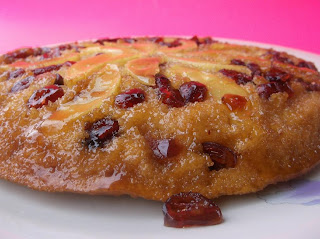
 Bailey's Irish Whiskey Cake 


Yes, I already know. There is no such thing as Bailey's Irish Whiskey. This beautifully scented, Irish cake is, however, brought to you by a Bailey and has a hint of Irish Whiskey both in the cake and on 'top'. You can, however, substitute a few drops of rum extract in the milk below or just leave out any hint of alcohol, and its' taste, altogether. The curdled milk is a great way of adding buttermilk flavor without the added expense while giving this upside down cake perfect flavor and moistness.


1/4 cup whole milk, half-and-half or light cream

1/2 cup Irish Apple Whiskey or Irish Apple Liqueur, divided 

1 teaspoon lemon juice

3/4 cup(1 1/2 sticks) butter or margarine, divided

1/4 cup brown sugar

1 large, firm apple. peeled, cored and wedged 1/2-inch thick

1/2 cup dried cranberries

1 1/2 cups flour

2 teaspoons baking powder

1/2 teaspoon ground ginger

1 cup brown sugar

2 eggs


In a small bowl, whisk together milk, 1/4 cup whiskey and lemon juice and let sit 30 minutes to curdle while preparing rest of recipe. Melt 4 tablespoons butter in a 9-inch round cake pan over low heat. Using a wooden spoon, stir in the brown sugar and cook, stirring for about 3 minutes until smooth and bubbling. Remove pan from heat.

Lay the apple slices on top of melted butter/brown sugar mixture decoratively. Sprinkle the dried cranberries over the top and evenly drizzle remainder of whiskey; set aside. In a bowl, whisk together flour, baking powder and ground ginger. In another bowl, beat remainder of butter and sugar on high until light and fluffy. Scrape down sides and add eggs; beating very well. Reduce speed to low and beat in the flour, a little at a time. Beat in the milk mixture just until moistened. Spoon batter over apples and even out top without disturbing the apple arrangement. Bake 35-40 minutes, or until toothpick inserted in middle come out clean. Cool cake in the pan for a couple of minutes and then run a knife around the edge of the pan to help release. Invert onto a serving platter or plate quickly and carefully. Serve warm or at room temperature. 


Deliciously Cheesy Irish Boxty   


Boxty's are prepared and cooked in many different variations. Some enjoy this 'must have' side to the classic British breakfast puffy and soft, while others enjoy it crispy. Being a Yankee, I enjoy crisp potato with my breakfast, and with the addition of Cheddar cheese, I think you will be making this year round. 


1/2 cup mashed potatoes

1/2 cup shredded raw potatoes

1/2 cup shredded apple

1/2 cup powdered rolled oats *

1/4 teaspoon each nutmeg, salt and black pepper

1/2 cup fat free evaporated milk

1/2 teaspoon baking powder

2 tablespoons oil

1/2 cup shredded Cheddar cheese


Place all ingredients, except oil and cheese, in a bowl and mix very well; set aside. Place oil in a large skillet over medium high heat. When hot, pour half the Boxty mix into the skillet, spreading it out to cover bottom of pan. Evenly sprinkle cheese over the top and pour remaining Boxty mix over the cheese. Again, spreading it out evenly, covering cheese. Reduce heat to medium low, cover and let cook for 6-8 minutes, or until well browned on the underside. Carefully flip over, cover and continue cooking an additional 6-8 minutes, or until browned on bottom as well. Remove from heat, cut into wedges and serve immediately. 


* This works so much better than the usual flour added to Boxty, but each are interchangeable. To make powdered rolled oats, simply place oats in a blender or food processor and pulse until it is in powdered form.


Wednesday, January 12, 2022

Biscuits and Molasses......remember?

    Although I like to think I am not that old, I am old enough to remember my father enjoying a side dish of molasses with his biscuits. Whether it was for breakfast, lunch or dinner, I don't recall there was ever a time when he didn't have a small bowl of that quintessential dish of molasses to spoon over each bite of buttered biscuit. He would split them in half, lather real butter on top and drizzle this sweet, dark, thick syrup at each mouthful. 

    And his biscuits were amazing! Fluffy on the inside and a mm layer or brown crispness on top. Why wouldn't he just dip the biscuit in the molasses instead of spooning? If you make a biscuit correctly, you will know that they are drier than yeast rolls or other types of baked breads, as they should be. They should let loose some crumbs ever time you bite them or slice them. Now many of you will cringe at the thought of eating both together. Many of you grew up with simple butter or maple syrup as additions to biscuits. There is something about mixing salty and sweet together that continues to be taunting us. 

    Now his biscuits weren't your run of the mill either. He always used buttemilk and half the time, he didn't have it on hand, so he would take the amount of whole milk called for in his recipe and add a tablespoon of apple cider vinegar and set it aside. After a couple of hours, it had separated into curds and whey. These lumps of soured milk and the whey at the bottom were each added to the mix and the result was an amazingly flavorful biscuit that I continue to make today. Not only does this clotted milk add flavor but it hepls immensely in the rising of the biscuit when working in conjunction with baking powder. So without talking on and on as a true Yankee, let me give you his recipe.


Real New England Biscuits


Makes 6(3-inch)biscuits

1 1/3 cup whole milk
1 tablespoon apple cider vinegar
2 cups flour
2 teaspoons baking powder
1/2 teaspoon salt
7 tablespoons butter or margarine

    Stir milk and vinegar in a bowl and set aside until it curdles, with visible lumps floating on top. This will take about an hour or two, depending on how warm your kitchen is. Obviously the warmer the environment, the quicker it will turn into curds and whey.

    When ready, preheat oven to 375-degrees F. blend flour, baking powder and salt together in a large bowl. Using a sturdy fork or your fingertips, crush the butter into the flour mixture until it resembles half the size of peas. Add soured milk and thoroughly mix until dough is mixed well. There will be lumps, which is perfectly normal. 

    Liberally flour your work surface and transfer dough to surface, Need only a couple times and press out until about 1 1/2-2-inches in thickness. I use a 3-inch cutter or mouth of a cup to cut out biscuits but you can cut them any size you want.

    Place cut biscuits on an ungreased pan and reshape dough in order to cut a couple more biscuits, kneading as little as possible in order to hold together. 
Once on pan, brush(or use your fingertips)milk, half and half or cream on top of each biscuit and bake 30-32 minutes, or until lightly browned on top. No need to check inside, they will be thoroughly cooked. 

    Remove from oven and immediately brush with melted butter or grab a stick of butter, pull some paper from the end and run it on top of each hot biscuit liberally. Set aside for a minute or two and enjoy. 


And don't forget the molasses!


Saturday, December 4, 2021

Thomases Progress

 Here is Thomas playing a selection of music that encompasses third position, which is hard in itself. But what I found out what was even harder for him to learn was vibrato. I never gave it much thought, but I can imagine it is difficult for a 10 year old, but he is doing fantastic! Hope you think so as well. Now I do want to say that I used my laptop to live feed it to facebook. Yes...I am still a dinosaur when it comes to anything tech related. So you will notice his bow strokes don't match the actual audio, being a second behind. For that, all I can do is apologize.


Monday, September 27, 2021

WOW!!! Over two months and not one single post.....


     I don't remember the last time I took so long to post something on this blog. Marketing professionals always tell me to post something at least once a week to keep your audience coming back, but you know something? I think family is much more important than audiences! That is why I got rid of my cell phone years ago, reverting to a simple landline WITHOUT an answering machine. As growing up, if someone wants to contact me and talk, they call and if I don't answer.....they call back. Life is much less stressful when you take control of your own life and do as you see appropriate. And my anxiety and stress levels have never been lower, which means my life is full and much more robust.

     Anyway, the past few months have been spending time with my 10 year old in a host of things, from sports, schooling, horse back riding and violin. He has been playing for a year and a half and finally is with the Bangor Symphony Youth Orchestra program, which he is very excited about. Although he has now joined the school band, he is not learning anything BUT is spending time with his friends during the practice sessions and it seems to have worked, keeping his interest high. He is the last of this generation to keep violin going and I couldn't be more proud. Five generations...think about that!

     I have also been working on my first nonfiction and just completed another book, on sale now on amazon here.


A simple, low content journal in time for the Holidays. It comes in both paperback and hard cover and is a keepsake to hand down throughout your family for generations to come so that they can refect on all the Holidays you enjoyed any given year. This is a 2 year journal and comes with tips, hacks and ideas to make those special days even more special. 

     Now I wouldn't be a true Yankee Chef if I didn't add a couple of my all-time favorite, fall recipes so here is my #! and #2 favorite recipes for this time of year. Enjoy and I will not wait so long again to write.


5-Minute Indian Pudding-Two Ways  


     The original Hasty Pudding, or Indian Pudding, is probably the very first dessert ever made on New England shores by our European ancestors. Don’t listen to other so called culinary historians when they note that Indian Pudding should be baked in order to be classic. This is entirely untrue! This New England dessert was made in a “great kettle” over the open fire. Eggs were not wasted in this pudding originally, and are not needed now. When eggs are added, then Indian Pudding should be baked, creating a firmer textured preparation.

     This recipe is perfectly spiced as our Yankee ancestors prepared, but with a little cranberry tartness added. By letting this 'hasty pudding' chill in the refrigerator, the dried cranberries absorb the liquid, making them soft, tender and super flavorful.


2 cups milk                                                                                        

1/2 cup dried cranberries or raisins, optional

1 1/2 teaspoons cinnamon                                                                  

1/2 cup molasses

1/2 cup sugar(optional but recommended)

3 tablespoons butter or margarine                                                  

1/4 teaspoon each nutmeg and dried ginger                                                               

1/3 cup plus 2 tablespoons cornmeal

1 tablespoon vanilla                                                                   

Vanilla ice cream or heavy cream if desired


Place first 7 ingredients in a medium saucepan and stir well. Place over medium high heat, stirring once or twice to prevent milk from scorching. Once milk mixture is scalding hot, and while constantly stirring with one hand, slowly pour the cornmeal into milk. Once added, reduce temperature to low and constantly stir for 2 minutes. It will thicken substantially.


Remove pan from heat and stir in vanilla. Transfer to a bowl and serve hot with vanilla ice cream melting over the top or cover and refrigerate until completely cold. Serve as is or with a dab of heavy cream over the top.


Makes about 3 servings or if your’e a Yankee….less


To make Baked Indian Pudding, double the amounts above, but use 1/2 cup cornmeal and simply allow stove top Indian Pudding to cool 10 minutes before slowly adding 2 beaten eggs. Pour into a greased 10-inch greased cake or pie pan and bake for 1 1/2 hours at 300-degrees F, or until the center is just firm.

Blueberry Coffee Cake


     I hate to start with the oven being turned on now. It just doesn't seem possible that both spring and summer has come and almost gone. I remember my father saying that HIS father used to repeat "Maine has 2 seasons. Winter and August". It is almost true. So sitting down to a great tasting New England coffee cake is a feel good snack or dessert. Even a husband can make this delightful cake.

Topping:
1/3 c. brown sugar
3 T. flour
1/2 t. cinnamon
2 T. butter or margarine, melted
Cake:
Nonstick cooking spray
2 c. flour
3/4 c. sugar
1 T. baking powder
1/4 c. butter or margarine, melted
3/4 c. milk
2 eggs
1 T. lemon juice
1 1/2 c. fresh or frozen blueberries


Preheat oven to 350-degrees F. Grease an 8-9-inch square baking pan or cake pan liberally with nonstick cooking spray; set aside.

In a small bowl, blend together brown sugar, flour and cinnamon. Add melted butter and stir until flour mixture is entirely moist; set aside.

In a large bowl, place all cake ingredients at once, except blueberries, and beat with an electric mixer until smooth. Fold in blueberries. Pour batter in prepared pan and evenly sprinkle crumb topping over the top. Bake 45-50 minutes, or until the topping is crisp and the cake bounces back when touched in the middle. Use a toothpick if needed to make sure it comes out clean. Remove from oven to cool slightly before cutting to serve.